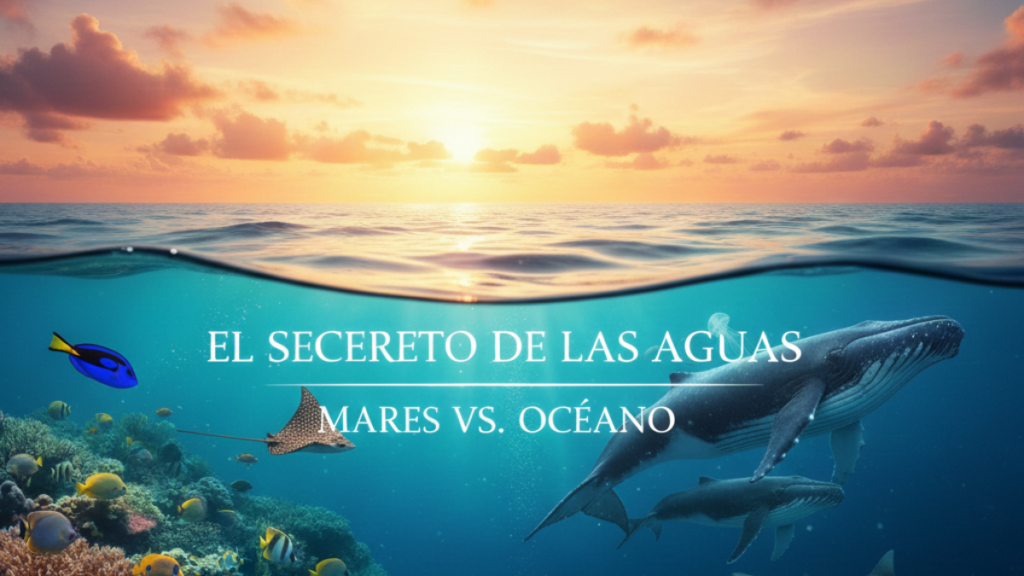
Do you know the differences between seas and oceans? Discover their secrets, the most incredible species living in them, and how to protect this endless treasure. Dive in!
Let’s be honest for a second. We grow up being told we live on “Planet Earth,” but one look at a map makes it clear it should be called “Planet Water.” More than 70% of the surface is covered by this vital liquid. Not all of that water is the same, though.
The confusion comes from the fact that, at the end of the day, it’s all saltwater and it’s all connected. Scientists call it the “Global Ocean.” But for us humans, categorizing is essential to understanding climate, navigation, and life itself. The fury of the North Atlantic is nothing like the crystal-clear calm of the Ionian Sea, right?
Size really does matter (a lot)
The first of the differences between seas and oceans that jumps out at you is scale. Oceans are the giants, the absolute owners of the space. They’re immense bodies of water that separate entire continents. When you picture an ocean, picture a distance that takes days or weeks to cross by ship.
Seas, on the other hand, are more “modest” in size. They’re usually parts of those oceans that sit closer to land, sometimes partially ringed by coastline or even almost completely enclosed.
Depth: the realm of darkness vs. the light
This is where things get interesting. Oceans are incredibly deep. We’re talking an average of roughly 13,000 feet (4,000 meters), with spots that reach 36,000 feet (11,000 meters), like the Mariana Trench. It’s a world of crushing pressure and total darkness.
Seas tend to be far shallower. Because they sit on the continental shelf, sunlight usually reaches much of the seafloor easily, which lets life explode in colors and shapes we can see while snorkeling or recreational diving.
The five giants: our oceans in detail
To really understand our world, we need to put names to these colossi. Each one has its own “personality,” its own currents, and its own challenges.
The Pacific Ocean: the undisputed ruler
It’s the largest and deepest of them all, covering a third of the planet’s surface. It’s so enormous that every continent combined could fit inside its basin. What fascinates me most about the Pacific is the “Ring of Fire,” a zone of intense volcanic and seismic activity that surrounds it.
- Biodiversity: it’s home to the Great Barrier Reef.
- Fun fact: despite its name (given by Magellan because he found it calm), it hosts some of the fiercest storms on the planet.
The Atlantic Ocean: the great connector
It’s the second largest and, for those of us in Spain, our closest neighbor. It separates the Americas from Europe and Africa. It’s a vital ocean for Europe’s climate thanks to the Gulf Stream, which carries warmth up from the Caribbean.
- Seafloor relief: right down the middle runs the Mid-Atlantic Ridge, an underwater mountain range that never stops growing.
The Indian Ocean: the warm giant
It’s the third largest ocean, and its waters tend to be warmer, which makes it a paradise for certain species but also leaves it sensitive to climate change. It has been essential to the historic trade routes between East and West.
The Southern and Arctic Oceans: the guardians of the cold
We often forget about them, but they’re the world’s thermal regulators. The Arctic, up north, is an ocean surrounded by land. The Southern Ocean, down south, is an ocean that surrounds a continent. Their role in the survival of the poles is critical.
Seas: the crown jewels close to home
If oceans are the world’s highways, seas are the neighborhoods with character. There are three main types we should tell apart to really know our stuff:
- Marginal seas: these open onto the ocean but are shallower. The Cantabrian Sea is a perfect example.
- Enclosed continental seas: these are almost closed off and connect to the ocean through a strait. Our beloved Mediterranean is the king of this category, linked to the Atlantic by the Strait of Gibraltar.
- Landlocked seas: technically giant saltwater lakes, like the Caspian Sea. They have no direct outlet to the ocean.
The Mediterranean Sea: our blue jewel
I can’t talk about seas without stopping here for a moment. “Mare Nostrum” is a one-of-a-kind ecosystem. Because it’s almost completely enclosed, its waters renew themselves very slowly (a full turnover through Gibraltar takes close to a century). That makes it incredibly rich in history and biodiversity, but also extremely vulnerable to pollution.
Life beneath the mirror: who lives where?
This is my favorite part. Marine biodiversity is a spectacle that beats any science fiction movie. Depending on whether we’re in open water, along the coast, or down in the abyss, the species change dramatically.
Sea dwellers (coastal waters)
In the seas, where light is plentiful, we find the highest density of “known” life.
- Posidonia meadows: especially in the Mediterranean, these plants (they’re not algae) are the lungs of the sea and a refuge for thousands of small fish.
- Cephalopods: octopuses, cuttlefish, and squid rule these waters with their astonishing intelligence.
- Reef and rock fish: groupers, scorpionfish, and an endless list of colorful species that depend on reefs and rocky bottoms.
The ocean nomads (open water)
Out here, life is all about endurance and speed.
- Great whales: blue whales, humpbacks, and orcas cross the oceans on epic migrations spanning thousands of miles.
- Sharks: big predators like the great white and the whale shark (the largest fish in the world) patrol these ocean waters.
- Tuna: these fish are the speedsters of the ocean, capable of crossing the Atlantic in record time.
The kingdom of the abyss: creatures that defy logic
If seas are the backyard garden, the ocean depths are another planet entirely. That’s another one of the differences between seas and oceans. Below about 3,300 feet (1,000 meters), we enter the aphotic zone: total darkness. There are no plants down there because there’s no photosynthesis. So what does everything live on?
It’s mind-blowing, but life down here depends on “marine snow” (organic debris drifting down from the layers above) and on chemosynthesis at hydrothermal vents.
Species that look like nightmares (but are fascinating)
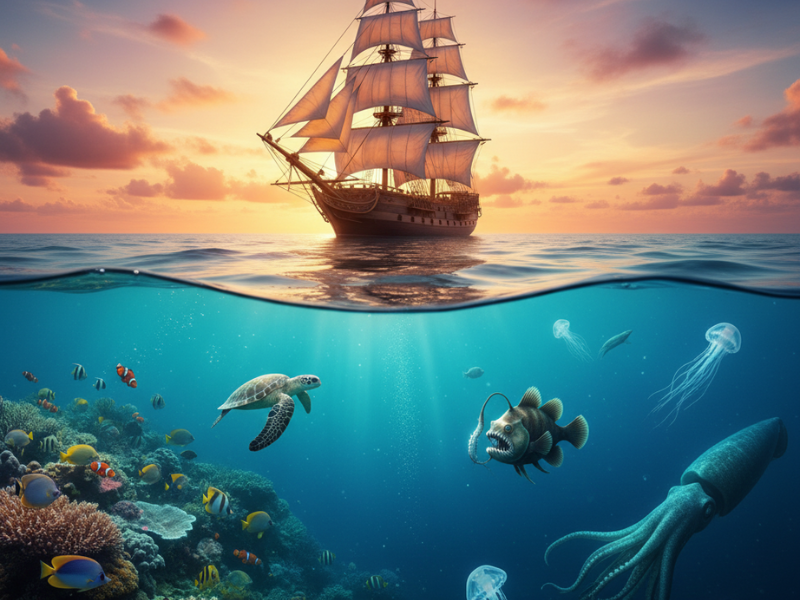
- Deep-sea anglerfish (Melanocetus johnsonii): you’ve definitely seen it in “Finding Nemo.” It’s the fish with the glowing lure on its head. That light is produced by bioluminescent bacteria and serves to draw in unsuspecting prey in the pitch black.
- Giant squid: for centuries it was a myth (the Kraken), but today we know it lives in the depths of every ocean. It can reach 46 feet (14 meters). It’s the eternal rival of the sperm whale in battles that play out miles below our feet.
- Blobfish (Psychrolutes marcidus): it got famous as “the ugliest fish in the world,” which is honestly unfair. In its own habitat, under enormous pressure, it looks perfectly normal. It’s only when you bring it to the surface that its gelatinous body collapses.
- Tardigrades and other extremophiles: in the deepest trenches, where the pressure would crush a steel submarine, there are microscopic creatures living happily right next to underwater volcanoes.
Why currents matter: the planet’s circulatory system
To understand why oceans are different from seas, you have to understand how they move. Oceans have global currents, actual rivers within the sea that carry heat, nutrients, and life.
The ocean conveyor belt
There’s a process called thermohaline circulation. Cold, salty water at the poles sinks and travels along the seafloor toward the equator, while warm water rises to the surface.
Why should you care? Because if that “belt” were to stop (a real concern with climate change), Europe’s climate would change radically. The sea isn’t static. It’s a thermal engine that keeps us from either freezing or roasting.
Real threats: what are we doing to our giants?
This is where I get a little more serious, but it’s necessary. Like I said at the start, my goal is for us to love the sea, and you can’t protect what you don’t know about, or what you don’t realize is in danger.
The plastic problem
It’s not just the Great Pacific Garbage Patch (already larger than France). The real issue is microplastics, those tiny fragments that fish mistake for food and that eventually end up on our plates. Some estimates suggest that by 2050 there could be more plastic than fish in the sea if we don’t change course now.
Ocean acidification
The oceans absorb a large share of the carbon dioxide we emit. That sounds like good news, but it comes at a price: the water becomes more acidic. That acidity dissolves mollusk shells and destroys coral skeletons. Without corals, we lose the ocean’s “nursery,” where most of the species we know are born.
How can we be part of the solution?
I don’t want you to leave with a bad taste in your mouth. Quite the opposite! There’s hope, and there’s a lot we can do. I always say we don’t need ten people doing it perfectly. We need millions of people doing it imperfectly but consciously.
- Responsible consumption: learn about the seafood you buy. Bottom trawling destroys the seafloor, while small-scale artisanal fishing respects natural cycles.
- Waste reduction: the best waste is the waste you never create. Avoid single-use plastics. That straw or plastic bag has a very good chance of ending up in a sea turtle’s stomach.
- Support for Marine Protected Areas: they’re like national parks underwater. In Spain we have wonderful examples such as the Columbretes Islands or Tabarca Island, where life bounces back with incredible force the moment we leave it alone.
The Blue Economy: the ocean as an engine of life
When we talk about the “Blue Economy,” we’re not just talking about the fishing boats we see at dawn. It’s a much bigger idea: recognizing that seas and oceans are a source of sustainable wealth if we know how to treat them.
The world’s pantry
More than 3 billion people around the world depend on marine and coastal biodiversity for their livelihoods. Here’s where the difference between seas and oceans comes into play, though.
- Marginal seas (like the Cantabrian or the Mediterranean) are where we’ve traditionally fished. They’re rich zones because light reaches the bottom and generates life quickly.
- Oceans, by contrast, are the stage for deep-sea commercial fishing. It’s a wilder environment and much harder to regulate, so international cooperation is key to keeping the pantry from being emptied.
Endless energy: the power of waves and tides
Have you ever noticed the sheer force of a breaking wave? That’s pure energy. We’re starting to develop technologies to harness the movement of the tides (tidal power) and the waves (wave power). Imagine a future where the lights in your home run directly on the force of the Atlantic. It’s clean, it’s inexhaustible, and it’s respectful.
Myths and realities: the “monsters” that turned out to be neighbors
Ever since humans started sailing, we’ve filled our maps with monsters. Do you know those old charts labeled “Hic sunt dracones” (Here be dragons)? The fun part is that many of those myths have a real basis.
The Kraken: from legend to science
For centuries, sailors told stories of giant squid sinking ships. Today we know that Architeuthis dux is real. It doesn’t sink ships, but it’s an impressive animal that lives in the ocean depths and can be as long as a city bus.
The song of the sirens
Many historians believe that early navigators, after months at sea and under a punishing sun, mistook manatees or seals for women with fish tails. They may not have been as beautiful as in the movies, but they’re fascinating animals!
The secrets of the Mediterranean and the Cantabrian Sea
Since we’re in Spain, I can’t resist zooming in on our own waters. We’re lucky enough to live between two completely different aquatic worlds.
The Cantabrian: rough and nutrient-rich
It’s a marginal sea that opens onto the Atlantic. Its waters are cold and in constant motion, which means they’re loaded with oxygen and nutrients. That’s why its seafood has such an intense, prized flavor. It’s a sea for the brave, with a narrow continental shelf that drops off fast toward the abyss.
The Mediterranean: a lake full of history
It’s so much more than sun and beaches. It’s a semi-enclosed sea with an extremely high evaporation rate. Did you know that without the water flowing in through the Strait of Gibraltar, the Mediterranean would eventually dry up? Its biodiversity is unique, with species found nowhere else on the planet (endemics), which makes it a treasure worth defending tooth and nail.
How you can help starting today
I know the ocean’s problems sometimes feel so big that we feel small. But remember: the ocean is made of drops. Here are a few practical ideas I use myself:
- Watch your sunscreen: many sunscreens contain oxybenzone, which is poison for corals and marine life. Look for mineral or “ocean friendly” options.
- Don’t take souvenirs: that shell on the shore isn’t a decoration. It’s the future home of a hermit crab, or it will break down into sand the beach needs. Leave nature where it is.
- Join a beach cleanup: it’s an experience that shifts your whole perspective. Once you see how many cotton swabs and cigarette butts end up in the sand, you become far more conscious in your daily life.
Hidden geology: what’s under all that water?
We sometimes imagine the ocean floor as an endless, boring plain of sand. Nothing could be further from the truth! If we drained all the water away, we’d see a landscape far more dramatic and rugged than anything on the surface.
Mid-ocean ridges: where the world is born
Picture a mountain range that runs from one end of the planet to the other beneath the water. Those are the ridges. In the middle of the Atlantic there’s a rift where magma pushes up constantly. Yes, the ocean is expanding. The Americas and Europe drift a few centimeters farther apart every year. It’s a living process, slow but unstoppable.
Ocean trenches: the flip side of mountains
If Everest is the roof of the world, trenches are its basement. The Mariana Trench is the deepest known place on Earth. If you dropped Everest into it, there would still be more than a mile of water left above the summit. The pressure down there is about 1,000 atmospheres. It’s like having an elephant balanced on your thumb, and even so, there’s life. It’s wild!
The continental slope: the great step down
This is the real border between sea and ocean. Seas generally sit on the continental shelf (the continuation of the continents underwater). But there comes a point where the seafloor plunges toward the abyssal plain. That “step” is the slope, and it’s where impressive turbidity currents form and where many large fish rise up from the depths to feed.
Climate and water: why the sea is your home’s thermostat
This one fascinates me because it affects our daily lives, whether you live on the coast or inland. The oceans absorb 90% of the excess heat generated by greenhouse gas emissions. They’re the planet’s great radiator.
Thermal capacity
Water takes far longer than land to heat up and to cool down. That’s why coastal cities have milder climates. The ocean acts as a buffer. Without the oceans, temperatures on Earth would be extreme and uninhabitable for us.
El Niño and La Niña
You’ve surely heard about them on the news. They’re shifts in water temperature in the Pacific Ocean that alter weather patterns worldwide. They can trigger brutal droughts in Australia or historic flooding in Peru. That gives you an idea of how something happening in the middle of the ocean, thousands of miles away, can decide whether it rains in your yard this year.
Fun facts that will surprise you
So you have something to talk about at your next dinner with friends, here are a few facts that tend to leave everyone speechless:
- There are rivers and lakes under the sea: no joke. On the ocean floor there are brine pools (water far saltier than the water around it) that collect in depressions. They have their own “surface” and their own waves, all of it underwater.
- The ocean’s gold: there’s gold dissolved in seawater. Estimates put it at around 20 million tons. The catch is that it’s so diluted that extracting it would cost more than the metal is worth.
- Underwater waterfalls: the largest one in the world sits beneath the Denmark Strait. It’s cold water pouring over an underwater cliff more than 10,000 feet (3,000 meters) tall. It’s far higher than any waterfall on land.
History on the seafloor: the largest museum in the world
As a history lover, I can’t forget that the seas and oceans hold more archaeological remains than every museum on land combined. From Spanish galleons loaded with treasure to entire cities swallowed by rising sea levels.
The Mediterranean, for instance, is a time capsule. Roman amphorae, Phoenician ships, and World War II wrecks rest there in absolute silence. Exploring the sea is, in many ways, traveling into our civilization’s past.
Your role in this great blue ecosystem
By now you’ve probably realized that the differences between seas and oceans are technical, but the connection between them and us is vital. We aren’t separate from nature. We’re part of this water cycle.
Every time you choose a product without microplastics, every time you pick up a stray net or bag on the beach, you’re sending a message of respect to the giants that let us breathe.
Frequently Asked Questions about Differences Between Seas and Oceans
Why can’t you drink seawater?
Because of the salt. Our kidneys would need more water than we’re actually drinking in order to process that much salinity, which would dehydrate us far faster.
What is the tallest mountain in the world beneath the sea?
It’s Mauna Kea in Hawaii. Measured from its base on the ocean floor to its summit, it stands more than 33,000 feet (10,000 meters) tall, beating Everest. It’s a submerged giant!
Is there oxygen in the deep sea?
Yes, thanks to the cold currents that sink from the poles carrying oxygen with them. Without those currents, the depths would be biological deserts.
What is the saltiest sea in the world?
It’s the Dead Sea, though technically it’s a lake. Among seas with an outlet, the Red Sea is one of the saltiest, due to high evaporation and very little rainfall.
Why is the sea blue?
It’s not the reflection of the sky (a widespread myth). Water absorbs red and yellow wavelengths more readily, letting the blue ones bounce back and reach our eyes. It’s pure light physics!
Are there more species left to discover?
Plenty! It’s estimated that we know less than 10% of the life inhabiting the ocean depths. We’ve explored the surface of the Moon more thoroughly than the floor of our own seas.
What is the difference between sea water and ocean water?
Chemically they’re nearly identical, but seas tend to have different salinity levels depending on how many rivers empty into them or whether they sit in very hot regions.
Blue connects us all
Making it this far means you truly care about this topic. We’ve seen that the differences between seas and oceans aren’t only a matter of geography, but of depth, of life, and of mystery. Oceans are the lungs and heart of the world, while seas are the nearby spaces that watched us grow as a civilization.
We’re at a critical moment. We’ve never known so much about the sea, yet it has never been so threatened. The good news is that there’s still time to turn the tide.
What surprised you most out of everything we covered? I’d love to know if there’s a specific topic here you’d like me to develop into its own post. Maybe more on abyssal animals, or on how tides work?
Don’t be shy, leave me a comment! I read every single one, and they help me keep creating content you’ll love.