Want to set up your first aquarium and actually nail it? Learn step by step how to create a vibrant, healthy, professional-looking ecosystem with this complete guide.
We live in a world moving at a thousand miles an hour. Stress, screens, concrete. Sometimes we just need to stop. For a lot of us, having an aquarium at home is an anchor to the natural world. It’s conservation on a small scale. Once you learn how the nitrogen cycle works, or how plants oxygenate water, you develop a special sensitivity toward our rivers and seas.
Setting up an aquarium is an exercise in patience, which is in short supply these days. But I promise you the reward of watching that perfect balance come together is worth every minute of the wait.
Planning to set up your first aquarium
Before you run out to the store, take a breath. The number one mistake is buying on impulse. You need to decide what kind of world you want to create. Do you want a lush green landscape full of plants (aquascaping)? Are you after a community tank with fish in every color? Or maybe African cichlids and their almost intelligent behavior are what fascinate you?
Size does matter (and not the way you think)
Here’s the first big truth: the larger the aquarium, the easier it is to maintain. It sounds backwards, but a bigger volume of water is far more stable. In a 5-gallon (20-liter) tank, any small slip-up (too much food, a fish that dies) sends the water parameters through the roof and everything falls apart. In a 25-gallon (100-liter) tank, you have a much wider margin for error.
If you have the space, my recommendation for setting up your first aquarium is something between 15 and 25 gallons (60 to 100 liters). It’s the ideal size to learn on without losing your mind, and it leaves you enough room for a nice community of fish.
Where should I put it?
Don’t just stick it anywhere. A full aquarium is heavy (a 25-gallon setup runs well over 200 pounds once you add glass, water, and substrate), so you need a solid stand. Also avoid direct sunlight unless you want your tank to look like green pea soup within two weeks. Look for a quiet spot, away from drafts and radiators.
The essential gear for setting up your first aquarium
For life to thrive, we need technology that mimics nature. Don’t cut corners on the basic equipment. Cheap gear ends up costing you more in the long run.
The tank: your canvas
These days there are gorgeous rimless options made from optical glass for total clarity. To get started, though, any quality glass tank will do the job.
Make sure it has a lid, or that the fish you choose aren’t professional jumpers.
The filter: the heart and lungs
This is the single most important piece. A filter doesn’t just clear away visible debris. Its main job is biological. It’s where the good bacteria live, the ones that turn toxic waste into harmless substances. Look for a filter that moves at least four to five times your tank’s total volume per hour. If you have 25 gallons (100 liters), you need a filter rated around 130 gallons (500 liters) per hour. Personally, I prefer canister or hang-on-back filters so nothing takes up space inside the tank.
The heater: a steady tropical climate
Most popular aquarium fish are tropical and need a stable temperature between 75 and 79°F (24 to 26°C). A heater with a thermostat is essential. Figure on roughly 3 to 4 watts per gallon (about 1 watt per liter).
Lighting: artificial sunshine
If you’re going to add live plants (and please do, they’re the best biological filter there is), you need proper lighting. A desk lamp won’t cut it. Look for aquarium-specific LED fixtures that cover the spectrum plants need for photosynthesis.
Substrate and decor: building the foundation
The floor of your aquarium is where life begins. You have inert substrates (sands or gravels that don’t affect the water) and nutrient-rich substrates (ideal for demanding plants).
As for decor, try to keep it natural. Treated driftwood, volcanic rock, or slate. Skip the plastic castles and the bubbling scuba divers. Beyond ruining the natural look, they can leach unwanted chemicals into the water.
Setting up your first aquarium step by step: from theory to practice
Once the gear is home, it’s showtime. Don’t start pouring water just yet, though. There’s a logical order that prevents disasters and keeps your stand from getting soaked.
1. Cleaning and prepping the tank
Start by cleaning the aquarium. Even a brand new one usually carries dust or bits of leftover silicone. Use only water and a clean cloth that has never touched soap. Never use household cleaning products, since any chemical residue would kill your fish within minutes.
2. Prepping the substrate
If you bought gravel or sand, rinse it. Put it in a bucket and run tap water through it until the water comes out clear. If it’s a nutrient-rich plant substrate, you normally don’t rinse it (check the manufacturer’s instructions), because you’d break down the granules and create a sludge that’s impossible to clean up.
3. Placing the hardscape (rocks and wood)
This is where you decide how the tank will look. Lay the substrate down first, sloping it slightly from back to front to create a sense of depth. Then position your stones and driftwood. Make sure the stones are aquarium-safe and won’t alter your pH (avoid limestone unless you want to raise water hardness). One tip: driftwood usually floats at first. You can glue it to a rock with cyanoacrylate or weigh it down for the first few weeks.
Filling the tank: the art of not stirring everything up
If you dump water in carelessly while setting up your first aquarium, the substrate will churn and your plants will go flying. The trick is to set a flat plate on the substrate, or lay down a sheet of plastic wrap, and pour the water very slowly onto it.
What water should you use?
Tap water is usually fine, but it contains chlorine and chloramines to make it safe for us to drink. For fish, that’s deadly. You need a water conditioner that neutralizes those chemicals instantly. Don’t trust the old “let the water sit for 24 hours” advice, because modern chloramines don’t evaporate on their own.
Cycling: the month of mandatory patience
This is where most people go wrong. You can’t add fish on day one after setting up your first aquarium. An aquarium is a closed system where fish waste turns into ammonia (toxic). You need a colony of bacteria to grow in the filter that converts that ammonia into nitrite (also toxic), and then into nitrate (far less harmful).
The process usually takes 30 to 40 days. During that stretch, the tank will be “empty” of fish but teeming with microscopic life.
How to speed up the process
You can add bottled commercial bacteria to help things along, or drop in a pinch of fish food every few days so the bacteria have something to feed on. You’ll know cycling is finished when a water test shows ammonia and nitrite both at zero.
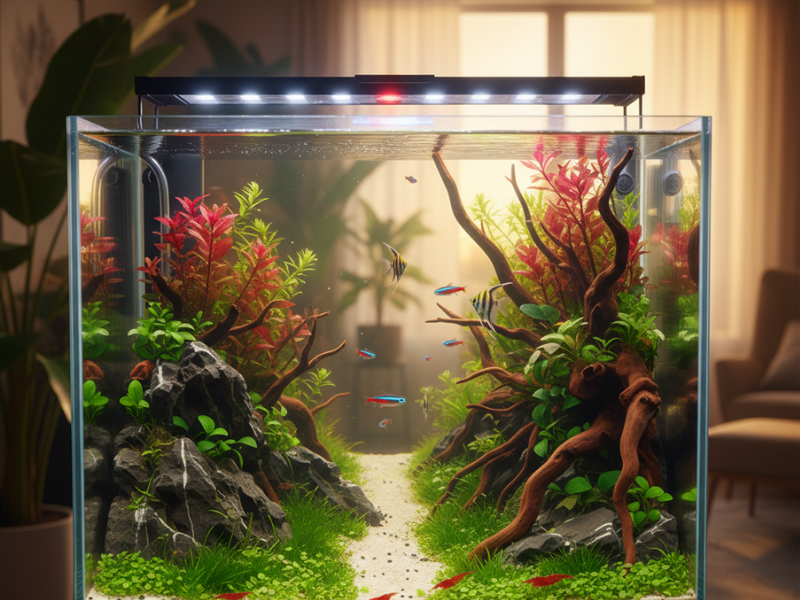
Why live plants matter
Don’t think of plants as decoration. Think of them as part of the filter. Plants consume the nitrates produced by the nitrogen cycle, helping keep the water clean.
- To start out: look for easy species like Anubias, Java fern, or Ambulia. They don’t need much light or supplemental CO2.
- Upkeep: it’s normal for some leaves to look rough at first while the plants adjust. Be patient and remove anything that dies so it doesn’t foul the water.
Water parameters: what you can’t see but can’t ignore
Not all water is the same when you’re setting up your first aquarium. You need to know at least three values before choosing your fish:
- pH: measures acidity or alkalinity. 7 is neutral.
- GH and KH: these measure hardness. Some fish need soft water (like Amazonian tetras) and others need hard water (like guppies or cichlids).
- Temperature: keeping it stable is key. Swings leave fish vulnerable to ich.
Choosing fish: compatibility and ethics
Compatibility comes first. Fish don’t just need to “get along.” They need to share the same water requirements. You can’t put a discus (acidic, soft water) with a molly (alkaline, hard water). It’s like trying to house a polar bear and a camel in the same enclosure.
Ideal fish for setting up your first aquarium
Depending on how hard the water is in your area, here’s what I’d recommend:
- Hard water: guppies, platies, and mollies. They’re tough, colorful, and breed easily.
- Soft water: tetras (like neons or cardinals), rasboras, and corydoras.
- Cleanup crew (essential): corydoras for the bottom, plus a snail like a nerite or some Neocaridina shrimp for algae.
The golden rule: don’t overstock
A tank crammed with fish is a tank headed for disaster. Waste will outpace what your filter can handle, and disease will follow. A rough guideline is 1 gallon of actual water per inch of adult fish, but it’s always better to understock than overstock.
How to introduce fish the right way
Never, under any circumstances, get home and dump a fish straight from the bag into the tank. The shock from temperature and parameter changes can kill it through stress alone.
- Temperature acclimation: float the sealed bag in the tank for 15 to 20 minutes so the temperatures equalize.
- Water acclimation: open the bag and add small cupfuls of your tank water into it every 5 to 10 minutes. Keep this up for about half an hour.
- The net: lift the fish out with a net and place it in the tank. Pour the bag water down the sink. Never add it to your aquarium, since it’s usually loaded with ammonia and possible pathogens from the store.
Weekly maintenance: the routine behind every success
If you want your aquarium to look like the ones in photos, you’ll have to put in some work. It isn’t much time, but it has to be consistent.
Water changes (replacing, not topping off)
A lot of people think topping off evaporated water is enough. Serious mistake. Evaporation leaves the salts and toxins behind. You need to siphon out 20% to 30% of the water weekly and replace it with fresh, conditioned water. The siphoning is the key part: run the tube through the gravel to vacuum up the food scraps and waste collecting on the bottom.
Cleaning the filter
Clean the filter when you notice the flow dropping off. Important: always rinse the sponges and ceramic media in the water you just siphoned out of the tank. If you use tap water, the chlorine will kill the bacteria you worked so hard to grow during cycling, and you’ll be starting from scratch.
Feeding: less is more
Roughly 80% of the problems people run into when setting up their first aquarium come from overfeeding. Whatever the fish don’t eat within two minutes rots on the bottom and sends toxin levels soaring.
- Feed once or twice a day.
- Use a varied diet: quality flakes, pellets, and the occasional frozen food (brine shrimp or bloodworms).
- Give them one fasting day a week. It helps clear out their digestive system.
Lighting: more than just seeing your fish
If you want a planted tank, lighting is your electric bill converted into life. Any old color-changing LED won’t do. This is where the concept of PAR (photosynthetically active radiation) comes in.
Light spectrum and lumens
For a beginner tank, we usually talk in terms of lumens per gallon.
- Low light: 55 to 75 lumens per gallon (15 to 20 per liter). Ideal for Anubias and ferns.
- Medium light: 115 to 150 lumens per gallon (30 to 40 per liter). At this level you can add simple carpeting plants.
- High light: more than 190 lumens per gallon (50 per liter). You’ll absolutely need CO2 here, or algae will take over.
Photoperiod: why the clock matters
An aquarium shouldn’t have the lights on for 12 hours. In nature there are clouds, shade, and sunrises. The ideal approach is to start with 6 hours of light a day and add half an hour each week until you reach 8 or 9. Push past that and algae will see a golden opportunity and take over the glass. Use a timer, because stability is the key to happiness in this hobby.
Algae control when setting up your first aquarium: the enemy that always comes back
If you set up an aquarium, you’re going to get algae. Accept it. They’re part of the ecosystem. The problem is when they turn into an infestation. They show up because of an imbalance between three factors: light, nitrates, and phosphates.
Common algae types and how to fight them
- Black beard algae: usually appears from CO2 fluctuations or poor circulation. It’s a nightmare. Siamese algae eaters or nerite snails help, but the real fix is stabilizing the water.
- Green spot algae: shows up on the glass. It signals that your phosphates are low relative to your nitrates. You scrape it off, but take the hint and dose a little potassium or phosphorus.
- Cyanobacteria: not algae at all, but a photosynthetic bacterium. It looks like a slimy green blanket and smells terrible. It comes from poor circulation and excess organic matter.
Water chemistry for non-chemists
This is where a lot of people get intimidated, but it’s simple if you treat it like a cooking recipe.
The nitrogen cycle (the technical version)
We already covered ammonia, but did you know its toxicity depends on pH? In acidic water (below 7), ammonia converts to ammonium, which is far less toxic. That’s why in hard, alkaline tanks (like cichlid setups) you have to be much stricter about water changes, because ammonia there is lethal on contact.
The role of CO2
Plants respire during the day. If you inject CO2 with proper equipment, you’ll see your plants “bubble” (pearling). Those are streams of pure oxygen being released. CO2 also acidifies the water, which helps bring your pH down if your tap water is very hard. Be careful, though: overdoing it at night, when the plants aren’t using it, can suffocate your fish.
Fish anatomy: what to look at to know they’re healthy
Learning to “read” your fish will save you a lot of heartache. A healthy fish holds its fins open and has bright, clear eyes.
Warning signs
- Gasping at the surface: low oxygen or a nitrite spike.
- White spots (ich): a parasite that shows up from stress or sudden temperature swings. It’s treated by raising the temperature to around 86°F (30°C) alongside medication.
- Sunken belly: internal parasites. Common when the diet lacks variety.
- Erratic swimming: swim bladder problems, sometimes caused by dry food (flakes) that fish gulp down along with air. Always soak the food before adding it.
Nutrient substrate vs. inert: which should you choose for your first aquarium?
This is one of the most common questions out there.
- Inert substrate (sand or gravel) contains no food for plants. If you want plants in it, you’ll need root tabs buried near the roots. It’s cleaner and doesn’t alter the water.
- Nutrient substrate is essentially fertilized soil. Plants grow like crazy, but it releases a lot of nutrients into the water early on. If you go this route, plan on 50% water changes every two days for the first couple of weeks to head off an algae bloom.
Design and aquascaping: the rule of thirds
If you’ve ever wondered why some aquariums look “professional” while others look like a pile of stuff, the answer is composition. In the design world, we use the rule of thirds.
Don’t put your focal element (the biggest stone or the most dramatic piece of wood) dead center. That splits the eye and makes the tank look smaller. Divide the front pane visually into three parts and place your points of interest along the dividing lines. This creates a visual tension that reads as far more natural and pleasing.
The vanishing point
Slope your substrate so it rises toward the back. If you create a “path” of light sand that narrows toward the rear between two rock formations, you’ll give the illusion of infinite depth. It’s a simple visual trick that completely changes how the tank reads in your living room.
Choosing plants for your first aquarium
Not all plants are created equal. If you’re just starting out and don’t want to deal with gas cylinders and daily dosing, you need bulletproof species.
Foreground plants (carpeting and low growers)
- Sagittaria subulata: one of the few carpeting plants that does well without CO2. It forms a lovely low lawn.
- Cryptocorynes: slow but reliable. Their browns and deep greens add a lot of natural character.
Midground plants
- Anubias (barteri, nana): the reigning champions of toughness. Heads up: they don’t get buried in the substrate. They have a rhizome (a sort of horizontal stem) that must stay exposed. Tie them down with fishing line or glue them to a rock or piece of wood with cyanoacrylate.
- Java fern: same as Anubias, it does best attached to the hardscape. Its long leaves add a lot of movement in the filter current.
Background plants (the fast growers)
- Ambulia (Limnophila sessiliflora): it grows so fast you can almost watch it move. Excellent for soaking up nitrates and keeping algae at bay.
- Vallisneria: creates curtains of long leaves that reach the surface, perfect for helping shy fish feel secure.
CO2 systems: do you really need one for your first aquarium?
Carbon is a plant’s primary food. If you want pearling plants and intense red coloration, CO2 is the way to get there.
- DIY CO2: made with yeast, sugar, and water in a bottle. It’s cheap and works for small tanks, but it’s unstable. Sometimes it produces a lot of gas and sometimes very little, which can send your pH all over the place.
- Pressurized CO2: a compressed gas cylinder with a regulator and solenoid valve. It’s an upfront investment (around $150 to $250), but it lasts forever and is extremely safe. You set it on a timer to come on with the lights and shut off at night.
If you’re going for a low-maintenance tank (low tech), forget CO2. If you want a showpiece aquarium (high tech), it’s your best ally.
Advanced fish compatibility: behaviors to know before setting up your first aquarium
We’ve covered water chemistry, but temperament matters just as much when you’re setting up your first aquarium. There are three behavior types to watch for:
Schooling fish
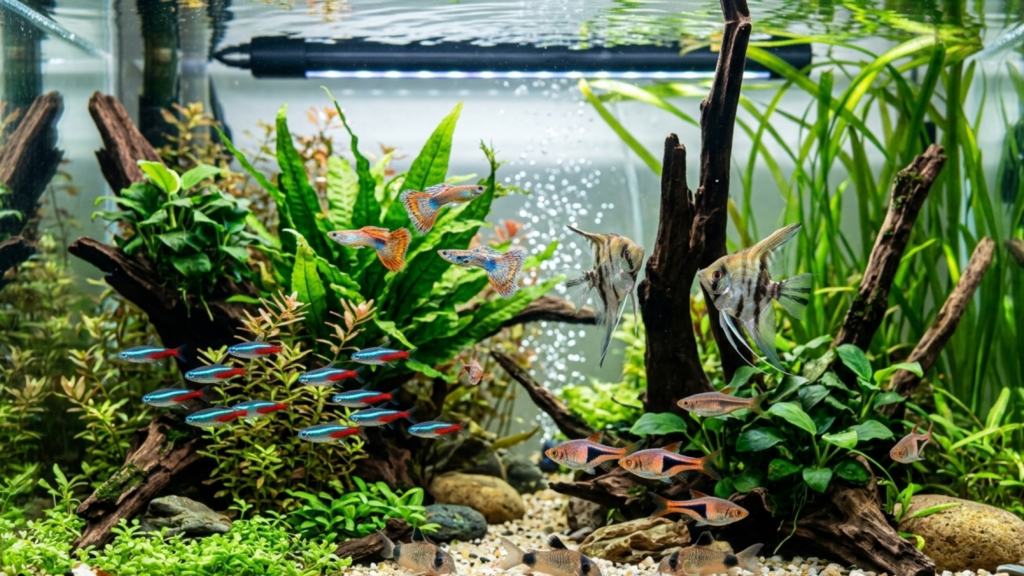
Neons, rasboras, and corydoras can’t be kept alone. They suffer brutal stress that eventually wrecks their immune system. They need groups of at least 8 to 10 individuals. Watching 20 neons move as one is about the most spectacular thing you can have in your home.
Territorial fish
The famous bettas and cichlids tend to want their own space. A male betta can never be housed with another male, and not with fish sporting showy tails either (guppies, for instance), because he’ll mistake them for rivals and attack.
Hierarchy among corydoras
They’re the tank’s janitors, but they have a fascinating social life. They should always be kept on fine sand, never sharp gravel, because it damages the barbels they use to find food.
The emergency kit nobody mentions when you set up your first aquarium
Sooner or later, something will go wrong. Keeping these three items in the cabinet will save your life (and your fish’s):
- A battery-powered air pump: if the power goes out for hours, the filter stops moving water and the fish will suffocate from lack of oxygen. A battery air pump buys you hours of breathing room.
- Aquarium salt (or additive-free sea salt): it’s the best preventive remedy for many external diseases, and it helps fish rebuild their protective slime coat after a harsh water change.
- Prime or another concentrated conditioner: if you accidentally overfeed, or a fish dies without you noticing, an ammonia spike can wipe out the whole tank. These products “lock up” ammonia toxicity for 24 to 48 hours, giving you time to react.
How do you know your aquarium is mature?
A “cycled” tank isn’t the same as a “mature” one. Cycling takes a month, but maturity takes about six. It’s the point where plants have rooted deeply, bacteria have colonized every corner of the substrate, and the water has that crystalline clarity that makes the fish look like they’re flying through air.
At that stage, maintenance gets much easier. The ecosystem knows how to defend itself against small fluctuations.
The budget: what does setting up your first aquarium really cost?
A lot of people abandon their tank because they never accounted for the ongoing costs. Let’s break it down so nothing catches you off guard:
- Startup cost: between the tank, a quality filter, substrate, and your first plants, a 20-gallon (80-liter) setup can run you $170 to $350. My advice: spend more on the filter and save on decor by using rocks you find in nature (as long as they aren’t limestone).
- Electricity: a mid-sized aquarium uses very little. The heater draws the most, but it only kicks on intermittently. Modern LED lighting uses just a few watts. Budget around $4 to $6 a month on your bill.
- Consumables: food, water conditioner, and test kits. A container of quality food can last you six months. It’s the smallest expense of all.
Photography: make your aquarium shine on Instagram
If you’ve put in the work to build a beautiful ecosystem, you’ll want to share it. Photographing glass with water behind it is tricky because of reflections. Here are my three foolproof tricks:
- Turn off every light in the room: the only light should come from the aquarium itself. That eliminates reflections from windows and from you.
- Clean the glass inside and out: the camera catches everything, even a fingerprint you can’t see.
- Use burst mode: fish don’t hold still. Fire off 20 shots in a row to get one where the fish is perfectly positioned and in focus.
Frequently Asked Questions about setting up your first aquarium
Why has my water turned cloudy white?
It’s usually a bacterial “bloom.” It’s normal early on, or if you cleaned the filter improperly. Don’t panic and don’t do a massive water change. It typically clears up on its own within a few days as the system balances out.
How long does an aquarium fish live?
It depends on the species. A neon tetra can live 3 to 5 years, while a goldfish (the classic orange one) can live more than 15 years if it’s in a proper aquarium rather than a glass bowl.
Are bubbles (an air pump) necessary?
If you have live plants and the filter outflow breaks the water surface with small ripples, it usually isn’t necessary. Gas exchange happens at the surface.
Can I keep coldwater fish with tropical fish?
It isn’t recommended. Coldwater fish (like goldfish) have a very fast metabolism, foul the water heavily, and need far more oxygen than tropicals. On top of that, tropicals would go sluggish at low temperatures and coldwater fish would be stressed at high ones. Each belongs in its own setup.
My plants are falling apart, what’s going on?
If you just bought them, it’s normal. It’s called melt. Many store plants are grown out of water (emersed). Once they go into your tank (submersed), the plant has to drop its old leaves and grow new ones adapted to living underwater. Don’t throw them out, give them two weeks.
Do I have to replace the filter media (sponges and bio rings)?
Almost never! Brands want you buying replacements every month, but that’s a mistake. Your bacteria live in those sponges and ceramics. Toss them and you kill the tank. Only replace them when they physically fall apart. Activated carbon is the exception: remove it after about two weeks, since it only serves to pull out medications or one-off chemical residues.
Why are my fish scratching against the rocks?
It could be the start of a parasitic infection, or an ammonia spike irritating their gills. Test the water immediately. If the levels look fine, watch for small white spots appearing on their skin.
How many hours of light are correct?
Start with 6 hours. If no algae shows up, move to 7 after two weeks. The ideal maximum is usually 8 or 9 hours. Anything beyond that is practically begging algae to appear.
Can I use rocks I find outdoors?
Yes, but do the acid test. Put a drop of muriatic acid (or strong vinegar) on the dry stone. If it fizzes, it’s limestone and it will drive your pH and hardness way up. If nothing happens, scrub it well, boil it if you want to be sure, and in it goes.
What do I do when I go on vacation?
If you’re gone less than a week, do nothing. Healthy fish handle 7 days without food just fine. That’s far better than asking a neighbor to feed them, because the neighbor always overfeeds, the water fouls, and you come home to a disaster. For longer than a week, use an automatic feeder.
Your window into the underwater world
Making it this far proves you have the patience it takes to set up your first aquarium. Remember that an aquarium isn’t a decorative object. It’s a commitment to living creatures that depend entirely on you. The satisfaction of watching your own balanced ecosystem, with crystal-clear water and fish that are breeding, can’t really be explained. You have to live it.
Don’t be afraid of making mistakes. We’ve all had algae, we’ve all lost a fish, and we’ve all flooded the floor at least once. What matters is figuring out why it happened and not giving up.
Still have questions about equipment or about a particular fish? Don’t hold back, drop a note in the comments below. I check in often to lend a hand, and I love seeing how your projects come along. Go for it, and enjoy the blue!
Setting up your first aquarium is a responsibility. Never release an aquarium fish or plant into a local river or pond. It’s one of the leading causes of invasive species that devastate our ecosystems. If you can’t care for your tank anymore, find a local club or return it to the store.
Building this ecosystem teaches you how fragile life is and how much chemical and biological balance matters. It’s a lesson in ecology in miniature.
So what do you think? Do you feel ready to kick off your first project? If you’re unsure which filter to buy for your tank size, or whether the fish you like can live together, leave a comment below. I usually respond fast, and that way we all help each other keep this hobby growing in a healthy direction.