The 10 most fascinating marine animals on the planet. Venomous killers, ocean giants, glow-in-the-dark species, and the strange wonders lurking in the deep.
Ever stand there staring at the ocean, thinking about everything happening under the surface? It hits me every time I’m on the beach.
You sit at the water’s edge, watch the waves roll in and out, and it’s easy to forget that under all that blue there’s a completely alien world. A universe with its own rules, its own light, its own shadows, and most of all its own residents.
I’ve felt a special pull to the ocean since I was a kid. I don’t know if it’s the same for you, but the sea recharges me in a way nothing else can, clean and direct.
When I’ve been through a rough stretch of work or I’m overthinking everything, I need to smell the salt to reset. Anyway, let’s get right into the list!
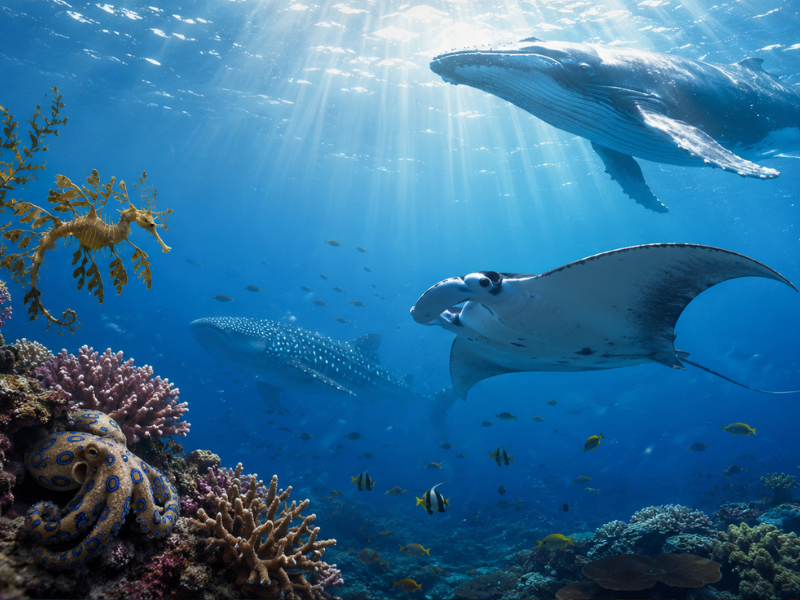
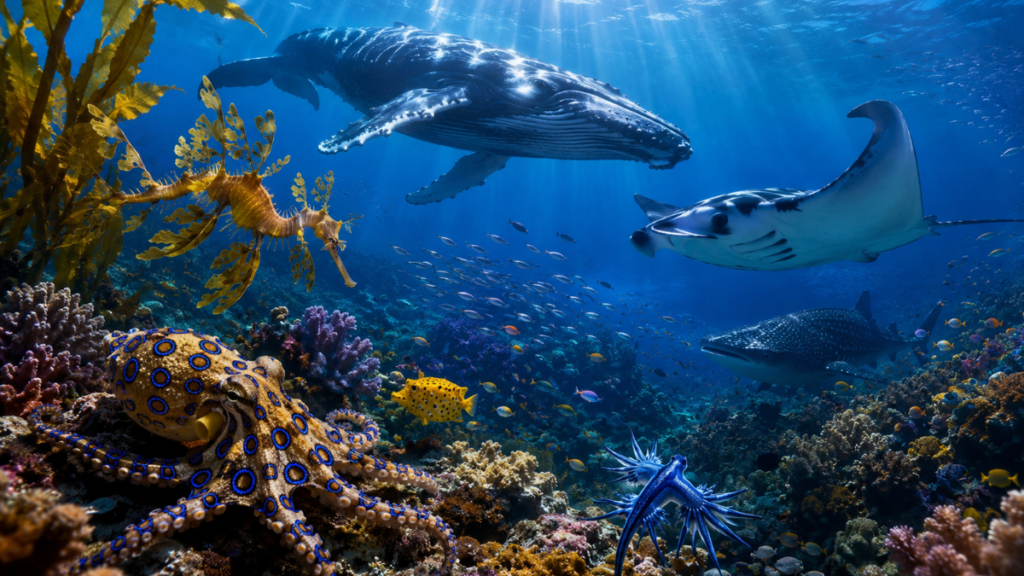
Images in this post were generated with AI assistance for illustration purposes
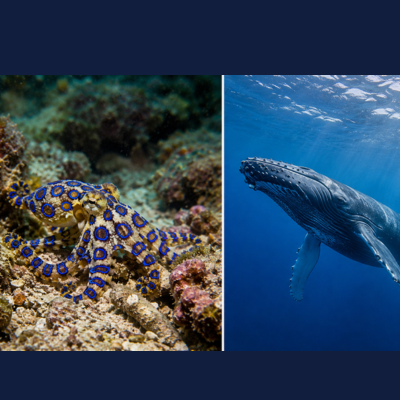
The blue-ringed octopus: the prettiest killer on the reef
A size that fools everyone
The first time I saw a video of this animal I couldn’t believe what I was watching. The blue-ringed octopus is tiny. Picture something that fits comfortably in the palm of your hand, weighing barely three ounces as an adult.
It lives mainly in the Indian and Pacific Oceans, moving between coral reefs and the tide pools that get exposed when the water pulls back.
At first glance, when it’s calm, it looks yellowish or brown, and it blends into the rocks and sand like it’s not even there. Prey walks right past it. So do most humans swimming nearby.
The moment it feels threatened or spooked by a stranger, though, its skin flips. Circles of electric blue appear across its body, glowing like they’re plugged in. It’s a warning sign, plain and unmistakable. Don’t come any closer.
The venom secret
What really makes this little cephalopod terrifying isn’t the look. It’s what it carries inside. Its saliva contains tetrodotoxin, a neurotoxin produced by bacteria living in its salivary glands.
To give you a sense of scale, this venom is a thousand times more potent than the cyanide you know from movies.
The blue-ringed octopus doesn’t need to bite hard to hurt you. Its beak, similar to a parrot’s, can punch through a crab’s shell or human skin so gently you barely feel the puncture.
Tetrodotoxin blocks the sodium channels in your neurons, which triggers progressive muscle paralysis. The horrifying part is that the victim stays completely conscious while their muscles, including the ones you use to breathe, shut down one by one.
To this day, there’s no specific antidote for the sting. The only way to save someone is assisted breathing until the body clears the toxin on its own.
Life on the seafloor
Despite all that firepower, the blue-ringed octopus is a shy, pretty peaceful animal in its day-to-day life. It doesn’t cruise the reef looking for a fight.
It uses its venom mostly to hunt crabs, shrimp, and small fish passing by its crevice. It creeps up on prey, launches itself, wraps it in its tentacles, and delivers a quick bite to inject the lethal saliva.
Within seconds, the prey goes still and the octopus can eat in peace without a scratch. Like most octopuses, they don’t live long. One to two years, tops.
The males die shortly after mating. The females spend the final months of their lives tending to their eggs, refusing food entirely until the eggs hatch. Then they die too, exhausted.
A short life cycle, but an intense one.
The humpback whale: the ocean’s acoustic architect
The mystery of the layered songs
Now let’s flip the scale completely and talk about the humpback whale. These giants, which can reach 50 feet long and weigh up to 40 tons, are famous around the world for their complex underwater songs.
If you’ve ever heard a recording of a humpback out in the middle of the ocean, you know it produces a feeling that’s hard to describe. Melancholy mixed with awe, running through your whole body.
The interesting part is that only the males sing, and they do it mostly during mating season. These aren’t random noises to communicate on the fly. They’re structured compositions with themes, phrases, and choruses that can run up to 20 minutes and repeat for hours.
Whales in the same geographic area sing the same song, and that song evolves over the months. They change notes, add fragments, tweak the rhythm, like they’re sharing a musical trend that travels through the water.
A fascinating cooperative hunting technique
If their communication impresses you, their feeding method will leave you speechless. Humpback whales regularly use a technique called bubble netting.
It’s teamwork, perfectly coordinated between several members of the group. A pod locates a school of fish or krill in the water column. Then several whales start swimming in circles beneath the school, blowing air out of their blowholes.
The bubbles rise to the surface creating a vertical curtain that terrifies the fish and forces them into a tighter and tighter space. Meanwhile, another whale emits a sharp sound that completely disorients the prey.
Once the circle closes and the fish are trapped at the center of the water column, the whales rise together from below with their mouths wide open, swallowing thousands of gallons of water full of food in a single gulp.
It’s a display of collective intelligence very few animals on the planet can match.
Extreme migrations to survive
These creatures are tireless travelers who don’t understand borders. They spend the summer months in the cold polar waters, feeding intensely to pack on body fat.
When winter hits, they set out on a journey of thousands of miles toward the warm equatorial waters to mate and give birth. During calving season, they barely eat, living exclusively off the fat reserves they built up months earlier at the poles.
Watching a mother tend to her calf, teaching it to breathe and shielding it from predators like orcas, is a lesson in care and persistence that reminds us how fragile life is, even in the largest beings on the planet.
The leafy sea dragon: the ultimate art of camouflage
Passing for a piece of seaweed
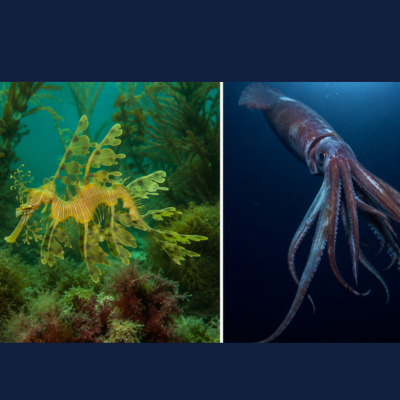
If we had to pick the animal that hides best in the ocean, the leafy sea dragon would win first place without breaking a sweat. A close relative of the seahorse, this creature looks pulled straight out of some ancient botanical legend.
Its entire body is covered in appendages that share the exact shape, color, and texture of the seaweed leaves it lives among.
It lives along the southern and western coasts of Australia, in shallow water. When you watch it drift, it’s almost impossible to tell it apart from a plant being carried by the current.
Unlike other animals that change color fast to camouflage themselves, such as octopuses, the leafy sea dragon puts its whole survival strategy on its fixed body shape and how it moves through the environment.
Nearly invisible locomotion
To keep the camouflage from breaking, this animal can’t swim conventionally the way any reef fish would. Any sharp movement would give it away to predators instantly by breaking the visual harmony of the scene.
To move, it uses pectoral and dorsal fins that are tiny and almost completely transparent. Those fins vibrate at high speed, pushing the animal along very slowly and softly through the water.
The result is that the sea dragon looks like it’s drifting, swaying from side to side, mimicking the way waves rock the marine vegetation. It moves so slowly it gives the impression of a dead leaf carried on the tide.
That lets it approach its prey, usually tiny crustaceans, without raising any suspicion. Since it has no teeth, it sucks them up through its long snout like a straw, using rapid negative pressure that gives the prey no time to react.
Shared parenthood on the seafloor
Just like with seahorses, the leafy sea dragon’s reproduction has a quirk I love telling people about. The fathers are the ones who carry the eggs the entire time.
The female deposits up to 200 bright pink eggs on the underside of the male’s tail, in a special patch of skin loaded with blood vessels. Unlike seahorses, sea dragons don’t have a brood pouch. They have what’s called a brood patch instead.
The male carries these eggs for about nine weeks, supplying them with oxygen through his own skin. When the time comes, the eggs hatch over several days and the tiny dragons emerge fully formed, though barely an inch long.
From second one of their lives, they’re completely independent and have to find their own food, trusting their beginner-level camouflage not to become dinner for other hungry fish.
The giant squid: the myth from the abyss
From sailors’ legends to scientific fact
For centuries, stories of ships pulled under by massive tentacled monsters filled the journals of sailors crossing the oceans.
The Kraken was the king of ocean terror in every port tavern. Today we know those legends had a real basis in the giant squid. This animal is one of the largest invertebrates in the world, reaching lengths of up to 43 feet in females, measured from the back of the body to the tips of its two long hunting tentacles.
What’s fascinating is how little we know about it, thanks to its inaccessible habitat. It lives in the ocean depths, typically starting around 1,600 feet down, where sunlight doesn’t reach and the pressure would crush any human.
For decades, the only specimens science could study were the ones that washed up dead on beaches or floated on the surface. We had to wait a long time to see the first video footage of one alive in its natural environment.
Eyes the size of dinner plates
Living in the dark requires extreme adaptations that are hard to picture from up here on the surface. The giant squid has the largest eyes in the entire animal kingdom, tied with the colossal squid.
They can measure up to 12 inches across, which is roughly the size of a dinner plate or a basketball.
These monster eyes aren’t designed to see detail in the dark the way night-vision goggles would in a movie. Their job is to catch the tiniest trace of bioluminescent light around them.
In the deep sea, many organisms produce their own light when they move through the water. If a sperm whale, its main predator, swims through the deep zone, it disturbs the water and makes the plankton glow faintly.
The giant squid can detect that flash from great distances with those enormous eyes, giving it precious seconds to escape before the whale spots it.
Titanic battles against sperm whales
The relationship between the giant squid and the sperm whale is one of the most intense rivalries in all of nature. Sperm whales regularly dive into the depths to hunt squid, because squid are their favorite food.
We know this because when sperm whales come up to breathe, many of them show massive circular scars on their skin, left by giant squid suckers during their fight for survival in the dark.
The giant squid’s suckers are armed with sharp, serrated chitin rings, which let it clamp onto the skin of its attackers to defend itself.
Even though the giant squid has eight arms and two long tentacles to fight with, plus a central beak strong enough to slice through flesh, most of the time the sperm whale wins because of its sheer size and power.
Picturing those clashes thousands of feet down, in total silence and total darkness, gives you a sense of how wild and mysterious the deep sea still is today.
The whale shark: the gentle giant of the open blue
The biggest fish in the world
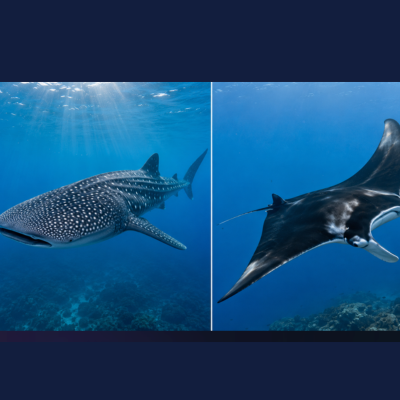
If you crossed paths with a whale shark in the middle of the ocean, your body’s first reaction would be fear because of its sheer size. This animal can top 40 feet long and weigh over 20 tons at maturity.
Its open mouth can measure up to 5 feet across when it’s feeding. It’s a monumental presence that commands total respect from anyone in the water.
Even though it belongs to the shark family, this giant is considered harmless to humans swimming alongside it. Scientists and divers call it a gentle giant. It has zero interest in attacking anything bigger than a small fish.
They’re slow-moving animals that cruise at an average speed of about 3 miles per hour, and they show a calm curiosity when they meet divers, letting us get close as long as we respect their space and don’t spook them with sudden movements.
A diet built on the smallest stuff
It’s genuinely strange that the biggest fish in the ocean feeds on some of the smallest organisms in nature. Its diet is mostly plankton, krill, crab larvae, and small schools of fish like sardines or anchovies that gather near the surface.
Unlike traditional carnivorous sharks that chase and bite prey with sharp teeth, the whale shark is a filter feeder that moves slowly through the water.
It swims with its mouth wide open, swallowing huge volumes of water constantly. It has modified structures in its gills that act as a giant strainer. The water enters through the mouth, passes through these filters that trap all the food, and then gets expelled through the gill slits on its sides.
Sometimes, if it finds a spot with a high concentration of food, it positions itself vertically in the water and starts actively suctioning, pumping up and down like a giant piston to force water and food into its system.
A spot pattern as unique as a fingerprint
One of the most beautiful visual features of the whale shark is its skin, no question. Its back is dark gray or bluish, covered in a regular pattern of white or yellowish lines and dots that pop against the blue water.
What makes this pattern really special is that it’s completely unique to each individual. No two whale sharks have the same spots. Scientists take advantage of this to study their populations without needing to attach uncomfortable physical tags.
Using visual recognition software originally developed by astronomers to identify star patterns in space, biologists photograph the area just behind the shark’s gills. The program analyzes the position of the dots and figures out whether that animal has been logged before somewhere else in the world, or if it’s a new individual.
That’s how we’ve discovered they undertake massive migrations, crossing entire oceans to reach areas where food explosions happen at certain times of year.
The giant manta ray: the elegance that hovers over the seafloor
Creatures with next-level intelligence
When you watch a giant manta ray move freely, the word that comes to mind immediately is elegance. Its movements don’t look like a regular fish’s. It gives the impression of flying through the ocean, beating those enormous pectoral fins, which can span up to 23 feet, with a smoothness that mesmerizes whoever’s watching.
Beyond the undeniable good looks, mantas are extremely intelligent animals. They have the largest brain of any marine fish in proportion to their body.
That brain power translates to complex social behavior in their everyday lives. They’re curious animals that actively interact with each other and with humans they encounter in the water.
It’s been documented that they can recognize their own reflection in a mirror placed by researchers, a cognitive ability shared with very few animals on Earth. That suggests a level of self-awareness we didn’t expect to find in a fish.
The mystery of their leaps out of the water
One of the most impressive spectacles you can witness at sea is watching mantas launch themselves out of the water without warning. These animals can shoot up from the depths and break the surface, rising several feet in the air before smacking flat against the water, making a dull thud you can hear from a long way off.
Marine biologists are still debating the exact reason for this dramatic behavior. There are several theories on the table.
Some suggest they do it to shake off parasites, using the hard impact against the surface to knock loose remoras or small crustaceans stuck to their skin.
Others think it’s a form of long-distance acoustic communication within the group, or maybe part of a courtship ritual during mating season.
Whatever the real reason turns out to be, seeing these enormous animals suspended in the air for a split second is something that stays with you forever.
Their mandatory visits to the cleaning stations
Giant mantas travel constantly through the deep blue, but they have fixed meeting points they return to throughout the year.
These are the cleaning stations. They’re usually located at specific coral reefs where small species of cleaner fish live and do this hygiene work.
When a manta arrives at a cleaning station, it slows down and hovers almost motionless in the current, taking a relaxed posture that invites the little fish to come in.
The cleaners swarm in and slip into its gills, its mouth, and across its entire skin, feeding on dead tissue, accumulated wounds, and parasites the manta has picked up on its travels across the open ocean.
It’s a perfect example of mutualism where everyone wins. The manta gets disinfected and stays healthy, while the little fish get a guaranteed daily feast with no need to hunt for food across the reef.
The yellow boxfish: aerodynamics that put engineers to shame
A bony structure shaped like a box
If we had to design a fish that’s the exact opposite of the classic hydrodynamic tuna, we’d end up drawing something close to the yellow boxfish.
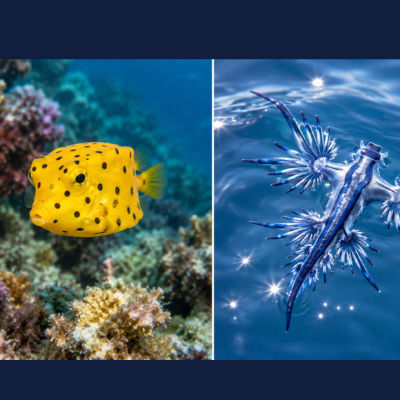
When they’re young, these little fish that live on the reefs of the Indian and Pacific Oceans look like bright yellow dice with black dots floating in the water. Charmingly weird.
Their anatomy is very unusual compared to other fish. Instead of a conventional internal skeleton covered in flexible muscle that lets them wriggle around, the boxfish’s body is locked inside a rigid, boxy bone shell, with only the fins, eyes, and tiny mouth sticking out.
That bony armor protects it very effectively from a lot of reef predators, but in exchange it can’t flex its body to swim the way other sea creatures do.
Stability lessons for the auto industry
For many years, scientists assumed the boxfish’s cube shape made it a clumsy, inefficient swimmer that struggled through the water. But once they started studying its behavior in wind tunnels and water flow channels in labs, they discovered the exact opposite.
Its shape creates very specific air and water flows that automatically stabilize the animal against the changing currents of a coral reef.
That discovery was so striking that in the early 2000s, a well-known car brand drew direct inspiration from the yellow boxfish to design a vehicle, trying to copy its low drag coefficient and high structural stability on the road.
Later studies have walked back some aspects of that aerodynamic story, but the boxfish is still a wonderful example of how nature finds clever, functional solutions to complex mechanical problems that we struggle to solve even with computers.
A lethal chemical defense system
Don’t let the friendly look and the slow-motion movements fool you. The yellow boxfish is holding an ace for when things get rough with some careless predator.
When it feels stressed, cornered, or attacked by a larger fish, its skin releases a toxin called pahutoxin through the mucus that covers its whole body.
That toxin dissolves fast in the surrounding water and destroys the red blood cells of any fish nearby, immediately shutting down the function of their gills.
It’s such a powerful defense that if a boxfish gets stressed inside a closed aquarium with other fish, the released toxin can wipe out every tank inhabitant within minutes, including the boxfish itself.
Out in the open sea, luckily for it, the current dilutes the toxin fast, letting the boxfish escape danger without collateral damage.
The blue dragon: the tiny floating hunter of the open sea
A shell-less mollusk that lives upside down
Now let’s move to an animal that looks like it came out of a fairy tale or a fantasy illustration, but that measures barely one to two inches long as an adult.
The blue dragon is actually a nudibranch, a type of sea slug that gave up having a shell in exchange for a free-floating life in the open ocean water column.
The most fascinating thing about its lifestyle is how it moves across the surface. The blue dragon floats on the ocean surface, but it does so completely upside down, belly facing the sky.
To stay afloat effortlessly, it swallows a small bubble of air and stores it in its stomach at all times. Its belly, which faces the sky, is a brilliant blue that blends into the color of the sea, hiding it from seabirds hunting for food from above.
Its back, which faces the depths, is a silvery gray that mixes with the reflection of sunlight on the surface, hiding it from predators swimming below. In biology this is called countershading, and it’s very effective on the open sea.
Feeding on venomous creatures without flinching
Despite its millimeter-scale size and delicate look that makes you want to protect it, the blue dragon is a voracious predator and extremely dangerous to its usual prey.
Its favorite meal is the Portuguese man o’ war, a marine organism famous for its extremely stinging tentacles that can cause serious burns to people swimming at the beach.
The blue dragon drifts up to the Portuguese man o’ war, latches onto it with its appendages, and starts eating it bite by bite, taking its time. The truly fascinating part is that this tiny animal is completely immune to its prey’s stinging cells.
Not only does it take no damage in its digestive system, but it’s able to absorb those venomous cells without triggering them, transport them through its body, and store them in the tips of its own appendages, called cerata.
That way, the blue dragon takes ownership of its meal’s weapons and uses them as its own defense mechanism against anyone who tries to bother it while it drifts across the sea.
A wandering life at the mercy of the wind
The blue dragon has no ability to swim against the current or move toward a fixed destination. It spends its whole life drifting through the temperate and tropical waters of the world, part of what scientists call the pleuston, the group of organisms that live right at the boundary between air and water.
Its movement depends entirely on the prevailing winds and surface currents that push the top layer of water. That means that when weather conditions align in the summer, thousands of these little blue dragons get swept en masse onto the beaches, along with the Portuguese man o’ war they feed on.
If you ever come across one on wet sand, just look at it with respect and do not touch it under any circumstances. The venom cells it’s collected from its prey are still active in its tissues, and they can give your hand a very painful sting.
The lanternfish: living lighthouses of the dark
Life in the ocean’s twilight zone
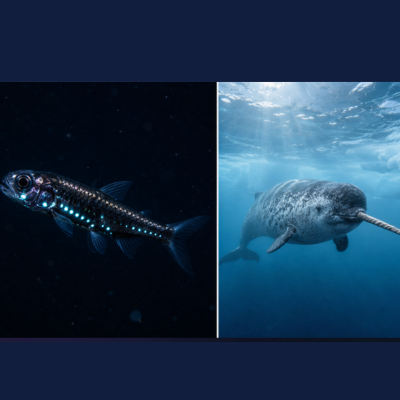
If we drop below 650 feet in the ocean, we enter the mesopelagic zone, also known as the twilight zone.
Here, sunlight fades gradually until it disappears completely as you keep going down. This hostile, dark environment is home to the lanternfish, a member of a very large family of small fish.
These fish are tiny, usually measuring between an inch and six inches depending on the species, but they’re among the most abundant animals on the entire planet in terms of total biomass.
They’re estimated to be a fundamental part of deep-sea fauna, serving as basic food for a huge range of larger predators that dive down looking for them, like squid, tuna, deep-sea sharks, and many marine mammals that need the energy to survive.
Bioluminescence as language and camouflage
What makes lanternfish special is their ability to produce their own light in the middle of the blackness, a biological phenomenon known as bioluminescence.
Their bodies are covered in small light-producing organs called photophores, mostly on their belly and along the sides of their body in a symmetrical pattern.
The placement of these photophores is so specific that it varies by species and by sex, working like a light-based code that lets them recognize each other in total darkness to form dense schools or find a mate during breeding season.
On top of that, they use this light for a very clever camouflage trick called counter-illumination. By lighting up their belly at the exact intensity of the faint light filtering down from the surface, they cancel out their own silhouette when a predator looks up at them, essentially becoming invisible in the ocean’s twilight.
The largest vertical migration on the planet
Every day, when the sun sets on the surface, lanternfish quietly pull off the largest mass movement of animals on the entire Earth without any of us noticing.
During daylight hours, they stay hidden in the safe depths of the ocean, between 1,300 and 3,300 feet down, to avoid being spotted by predators that hunt by sight.
When night falls and darkness covers the surface, millions of these fish swim upward, climbing hundreds of feet to feed on the rich plankton abundant in the upper layers of the water.
Before dawn breaks and the first sun rays start lighting up the sea again, they head back to the dark depths, where they’ll spend the day protected.
This daily vertical migration is vital to the health of the whole planet. It functions as a genuine biological carbon pump, moving tons of carbon from the surface to the seafloor every day, helping regulate the Earth’s global climate from the shadows.
The narwhal: the real unicorn of the frozen Arctic
A tusk that defies imagination
To close out our list of fascinating marine animals, we need to travel mentally to the frigid waters of the Arctic Ocean, near the North Pole. This is where the narwhal lives, a cetacean related to the beluga, famous around the world for its incredibly long tusk sticking out of its head, which in some adult specimens can reach nearly 10 feet in length.
During the Middle Ages, narwhal tusks that washed up on European coasts were sold by merchants as genuine unicorn horns, fetching astronomical prices in the royal courts because they were believed to have healing properties against poisons.
In reality, this tusk isn’t a horn growing out of the frontal bone. It’s a modification of the male’s left incisor tooth, which pierces through the upper lip and grows forward continuously in a perfect spiral. Females rarely develop this tusk in their lifetime, though a handful of exceptional cases have been documented in the history of marine biology.
A high-tech sensory organ
For centuries, naturalists assumed narwhals used that long tusk as a combat weapon to fight each other over females in mating season, to punch through the thick Arctic ice when they needed to breathe, or to spear prey on the seafloor.
Recent scientific research has revealed the reality is far more complex and subtle than we thought. The narwhal’s tusk is completely lacking enamel on its outer surface and is riddled with millions of nerve endings connected directly to the cetacean’s brain.
It works as an extremely sensitive sensory organ that picks up changes in its environment. Through it, the narwhal can perceive the tiniest changes in water temperature, pressure, salinity levels, and chemical compound concentrations in the sea.
This is enormously useful for navigating the Arctic’s mazes of sea ice, letting them locate the open water channels they need to surface for air before the ice closes over their heads and traps them without oxygen.
Deep-diving champions in frozen water
Narwhals are genuine deep-sea athletes, even if they don’t look like fast-moving fish. Despite living in an environment covered in ice most of the year, they’re capable of some of the deepest dives ever recorded in marine mammals, regularly reaching depths of over 4,900 feet to feed on Arctic cod, halibut, and squid living pressed against the polar seafloor.
These dives can last close to 30 minutes and require very special physiological adaptations in their bodies, like muscle rich in myoglobin capable of storing large amounts of oxygen, and a flexible ribcage that can collapse under the immense water pressure without suffering internal injury.
Watching a group of narwhals surface together in a small crack in the Arctic ice, exhaling with a dull sound that breaks the frozen silence of the north, is one of the most moving images of wildlife on our planet, and one we need to protect at all costs.
The state of the ocean today
The real threats marine life is up against
Now that we’ve traveled the world together getting to know these ten fascinating marine creatures, it’s time to come back down to earth and talk honestly about what’s happening at sea.
The ocean is facing a series of very serious challenges caused by human activity accumulated over decades. This isn’t about scaring anyone or getting gloomy. It’s about being aware of the reality so we can do something about it before it’s too late.
Plastic pollution is one of the most visible problems on today’s coastlines. Every year, millions of tons of plastic waste end up in the sea because of poor management on land.
Larger animals like humpback whales or whale sharks can ingest it by accident while filtering water to feed at the surface. The smaller pieces, microplastics, enter the food chain from the bottom, consumed by plankton and lanternfish, eventually affecting the entire global ecosystem.
Climate change is another reality altering underwater living conditions at breakneck speed. Rising atmospheric temperatures are also warming the oceans, disrupting traditional marine currents.
Overfishing is the third major pillar of this problem. Uncontrolled catches are depleting the populations of many commercial species and, by knock-on effect, hurting the large predators that no longer have enough food to raise their young.
On top of that, destructive fishing gear damages deep ecosystems and causes accidental bycatch of manta rays and other marine mammals that get trapped in abandoned nets.
Small everyday actions that make a difference
Sometimes, when we think about the ocean’s global problems, we feel small and powerless against the scale of the situation. We assume what we do at home doesn’t matter, but that’s a mistake worth throwing out.
The health of the sea starts with each of our daily consumption habits. Cutting back as much as possible on single-use plastics in our daily shopping is a fundamental step everyone can take starting tomorrow.
Keeping that waste out of rivers and off beaches is the best way to protect marine creatures from accidental ingestion. It’s also important to inform yourself about where the seafood you buy comes from, always choosing options from sustainable, local fisheries that respect the sea’s life cycles and minimum catch sizes.
The critical role of marine protected areas
Science has shown time and time again that when a section of the ocean is strictly protected from industrial fishing and resource extraction, nature bounces back at a speed that gives us hope.
Marine reserves function as genuine oases of life where species can reproduce, feed, and grow without any external pressure.
Over time, these protected spaces fill with life and the animals naturally repopulate the surrounding waters that are still open to human activity. Backing local and international initiatives to expand these protected areas is essential if we want to guarantee that future generations can keep sharing the planet with the fascinating animals we’ve covered today.
Fascinating marine animals FAQs
What’s the most dangerous marine animal in the world?
If we measure danger by the potency of the venom and the total absence of a medical antidote, the blue-ringed octopus ranks near the top of the list. That said, in day-to-day life at beaches around the world, box jellyfish stings cause more serious accidents because of accidental contact in swim areas where people can’t see the transparent tentacles in the water.
How do marine animals handle the pressure at the bottom of the sea?
Animals that live in the deep sea, like the giant squid, don’t have air-filled internal cavities in their bodies (no large lungs or rigid swim bladders) that could collapse under the outside water pressure.
Their bodies are made mostly of water and highly flexible gelatinous tissue that carries the same internal pressure as the surrounding water, letting them move without getting crushed thousands of feet down.
Why are sharks so important to ocean health?
Sharks act as the ocean’s health inspectors across every region of the planet. Sitting at the top of the food chain, they hunt the sick, injured, or weakest animals from other species below them, keeping fish populations healthy and stable over time.
Without sharks in the ecosystem, mid-level predators multiply out of control, wiping out reef food supplies and triggering the collapse of the marine life connected to them.
Can you visit these marine animals in their natural habitat?
Yes, many of these species can be observed in the wild through regulated, responsible ecotourism in several countries.
Controlled zones exist in Mexico, the Maldives, and Australia where you can swim alongside whale sharks or giant mantas under strict rules of behavior that keep both the animals and the divers safe.
It’s a fantastic form of public awareness that also generates income for the local communities that protect these species.
What is bioluminescence and how many animals use it?
Bioluminescence is the natural ability to produce light through an internal chemical reaction, usually involving luciferin-type molecules and luciferase enzymes.
It’s estimated that more than 70 percent of the animals living in the ocean depths produce some kind of light in their bodies, using it to communicate in the darkness, find mates during breeding season, hunt prey, or defend themselves from predators trying to attack them.
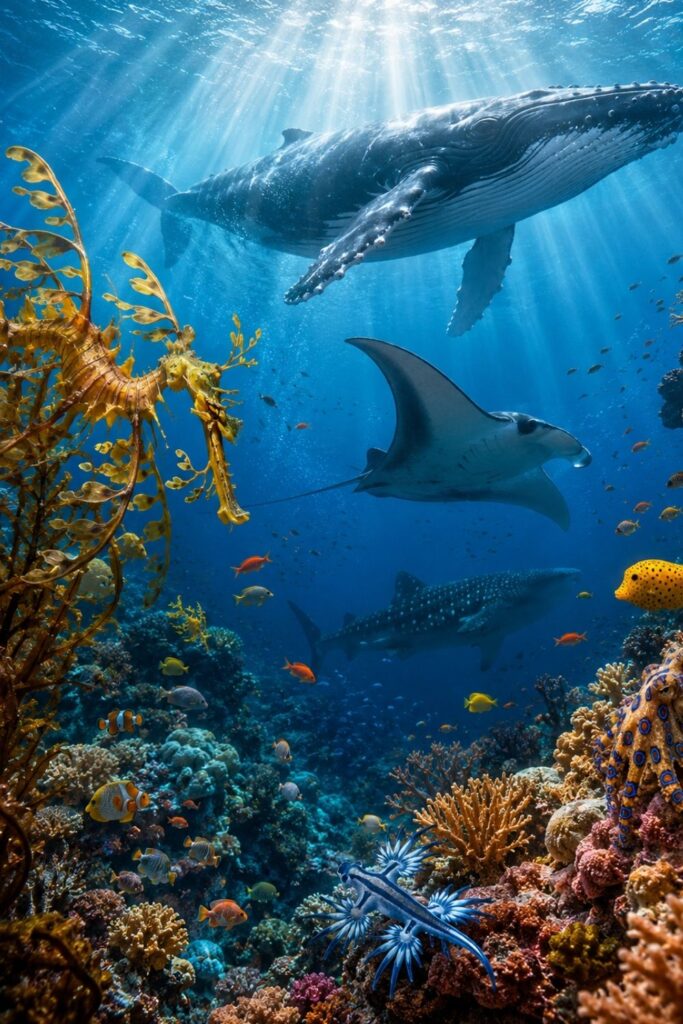
Along this journey through the ocean, we’ve seen that life underwater is rich, diverse, and full of wonderful corners we’re barely starting to understand with new technologies.
Every one of these creatures, from the tiny blue dragon drifting on the surface to the immense humpback whale crossing the seas, plays an essential role in the ecological balance of the planet we all share.
I always like to remember that Earth is really a planet of salt and fresh water, and that our well-being on dry land is tied directly to the well-being of the open sea. Taking care of them is, at heart, taking care of ourselves and our future.
What did you think of this trip through the deep? Which of these ten marine animals caught your attention most, or struck you as the most curious of the bunch?
If you’ve been lucky enough to see any of them up close while diving on vacation or out on a boat, I’d love for you to tell me about it in the comments section below.