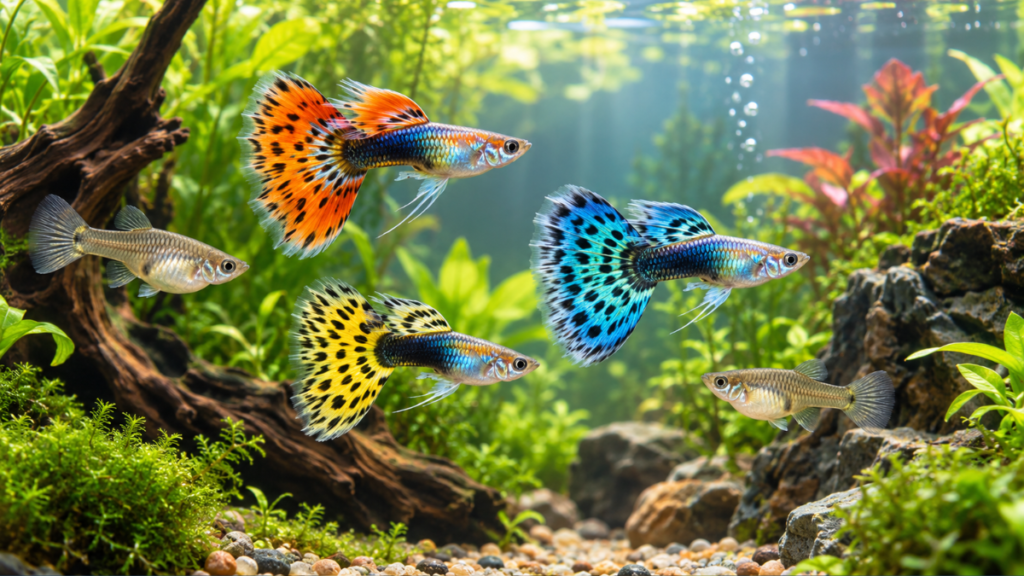
Your essential guide to guppies: learn about their care, breeding, varieties, and aquarium secrets from someone who’s been there.
I’ve had aquariums at home for quite a few years now, and if I’m being honest, very few fish have hooked me the way guppies have. Whether you’re just getting started in the world of fishkeeping, or you’ve been at it for a while but want to truly understand these colorful little swimmers, I promise this article will give you exactly what you need.
Guppies, whose scientific name is Poecilia reticulata, are probably the undisputed royalty of freshwater fishkeeping worldwide.
They’re incredibly hardy, they come in a color palette that looks like it was pulled from an Impressionist painting, they move with an effortless elegance, and let’s not kid ourselves, they’re insanely fun to watch when you sit down in front of the glass for a while.
Throughout this article, we’re going to break down every corner of this fish’s life. From its wild origins in nature to how to set up the perfect home for them, covering their ideal diet, the most common diseases, how their fascinating breeding works, and why keeping them at home is an experience that truly gets you hooked.
Get comfortable, grab a warm cup of something, and stick with me, because we’re going to take our time diving into the wonderful world of the guppy.
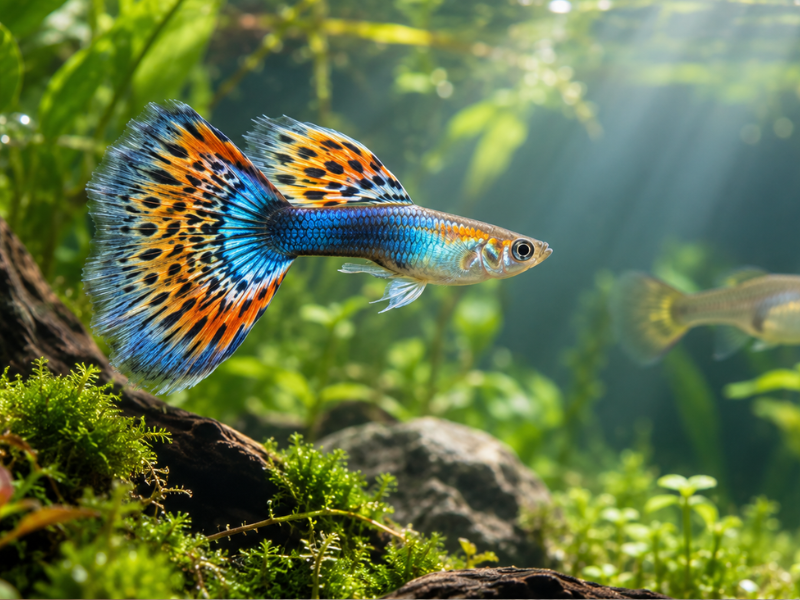
Guppy (illustrative image)
This post contains affiliate links; see the disclosure for details.
Origin and natural habitat of the guppy
To really understand any animal, the first thing I usually do is look at where it comes from and what conditions shaped its evolution over thousands of years.
Even though today we’re used to seeing them in perfectly maintained glass tanks, lit with LEDs and decorated with exotic plants, the guppy has a wild history that’s genuinely interesting and full of nuance, well worth knowing in depth to understand its current behavior.
Originally, these fish come from the tropical regions of South America and the Caribbean. If you look closely at a map, think of countries like Venezuela, Trinidad and Tobago, Guyana, or northern Brazil.
There, in their wild state, they live in a surprisingly wide variety of aquatic environments, ranging from small freshwater streams, seasonal pools, and shallow ditches to river mouths where freshwater mixes slightly with the saltiness of the sea, showing from the very beginning a truly enviable ecological versatility.
In their natural habitat, the water tends to be warm and constantly moving, well-oxygenated and naturally filtered by the riverside vegetation, submerged tree roots, and layers of decomposing leaves that carpet the bottom.
This tropical origin explains why we need to maintain very specific temperature and water quality parameters in our home aquariums if we want them to stay healthy, active, and showing off their brightest colors.
We’re not talking about delicate fish raised in sterile labs, but natural-born survivors that have adapted beautifully to currents, seasonal fluctuations, and the constant presence of predators in the wild.
Interestingly, because of their natural appetite for mosquito larvae, guppies were introduced on a massive scale to many tropical and subtropical regions around the world in the early 20th century, mainly as a biological control measure to fight insect-borne diseases like malaria and dengue.
This proves beyond any doubt that we’re dealing with a hardy fish, with an astonishing ability to colonize new environments, capable of adapting to unfamiliar spaces as long as conditions are even remotely favorable.
Anatomy and physical traits: What does a guppy actually look like?
One of the first things that catches your eye when you look at a community aquarium full of guppies is that no two seem to be alike. Or at least, that’s what jumps out thanks to the incredible color variety they display.
Beyond the colors, though, there’s such a dramatic sexual dimorphism that when you’re a beginner in this hobby, you can barely believe the males and females belong to the same biological species.
Males: the undisputed kings of color and elegance
Males steal almost all the aesthetic spotlight in any aquarium. They’re noticeably smaller than females, typically measuring between three and four centimeters in total length from the tip of the snout to where the tail begins. In exchange for their smaller body size, Mother Nature went all out with them: they have vibrant colors, metallic flashes that shift depending on how the light hits them, geometric stripes, polka dots, leopard spots, and above all, dorsal and caudal fins that are disproportionately large, showy, and elegant.
There are so many tail shape varieties in males that professional breeders and advanced hobbyists have meticulously classified them over decades of rigorous genetic selection.
Among the best known are the veil tail, broad and flowing; the fan tail, spread symmetrically like a perfect triangle; the lyretail, with two outer extensions shaped like filaments; the swordtail, with one or two pointed extensions; and the round tail, much more classic and compact.
Each of these shapes brings a unique flair, movement, and grace when the males swim through the aquarium showing off their charms to get noticed.
Females: understated, sturdy, and larger in size
Females, on the other hand, play in a completely different league both aesthetically and functionally. They’re noticeably larger than males, reaching six or even seven centimeters under optimal feeding and space conditions, but their color pattern is much more muted and understated.
Their bodies tend to show predominantly gray, silver, or dull brown tones, sometimes with a slight touch of translucent or iridescent color on the caudal fin.
This stark difference isn’t some random genetic quirk but a survival strategy shaped by evolution: in the wild, females need to go completely unnoticed by predators, especially when they’re pregnant and moving more slowly due to the weight of the developing embryos.
Males, on the other hand, rely on their quick reflexes for survival and on intensely catching the attention of the females themselves to carry on the species.
Internal anatomy and the gonopodium
Another key detail that sets the two sexes apart and is absolutely essential to know is the transformation of the anal fin. In males, this fin located on the underside of the body has evolved into an elongated, mobile copulatory organ called the gonopodium.
This organ works as a rigid tube that allows them to transfer sperm directly into the female’s body. Females, meanwhile, keep a traditional anal fin that’s much wider, rounder, and fan-shaped.
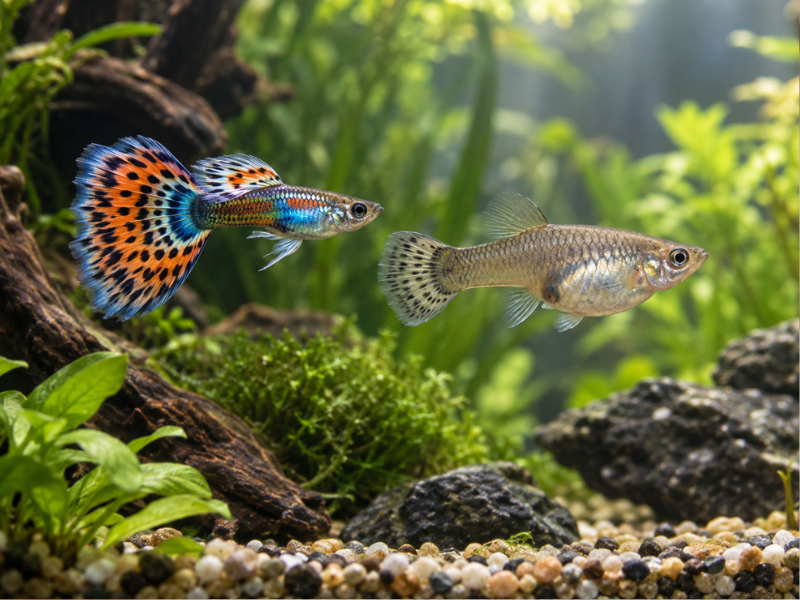
Male on the left and female (image generated for illustrative purposes)
The ideal aquarium for your guppies: Setup, space, and parameters
Keeping guppies happy and healthy means following certain basic rules about water volume, water chemistry, and regular maintenance.
A lot of people make the rookie mistake of putting them in round bowls with no filtration or heating, and of course, the result is usually frustrating and sad. Let’s look at how to do things right from the start so you can avoid the headaches.
Tank size and stocking density
Even though a single guppy is a small fish, they’re very active animals that swim constantly throughout the entire tank, and as we’ll see later in the breeding section, they multiply incredibly easily. My recommendation is to never start with a tank smaller than ten to thirteen gallons in capacity.
A tank that size lets you keep a balanced starter group of about five or six fish without the water quality spiraling out of control right away from waste buildup.
The larger the tank volume, the more stable the internal biological ecosystem will be and the fewer maintenance headaches you’ll deal with.
A small tank can swing dangerously within hours, while a medium-sized one is much more forgiving of little beginner mistakes. There’s a full guide on avoiding those mistakes in this post.
Water chemistry parameters
Guppies especially like water that’s moderately hard to hard, with a pH that sits in the slightly alkaline range. They don’t feel comfortable in water that’s too acidic or soft, since their metabolism is adapted to mineralized environments.
- Temperature: ideally keep it stable between 75 and 79 degrees Fahrenheit. A good heater with a reliable thermostat is recommended to prevent nighttime temperature drops.
- pH: they feel most comfortable in a range of 7.0 to 8.0.
- Total hardness: aim for values between 10 and 20 dGH. They like water with a solid amount of dissolved minerals.
If your tap water is very soft, there are simple and safe methods to remineralize it using specific commercial salts, though the vast majority of commercially bred guppies already adapt quite well to standard tap water as long as the tank’s biological cycle has properly matured (here’s a guide on cycling your tank).
Filtration, flow, and oxygenation
The filter is hands down the lungs of any home aquarium. To keep guppies, you need a filtration system that moves the water smoothly and keeps things clean, but without creating currents strong enough to physically exhaust the fish as they swim.
A hang-on-back filter or an internal filter with adjustable flow tends to work great in these tanks.
It’s also very important to make sure you place a fine sponge cover over the intake if you plan on breeding, since newborn fry are so tiny they could accidentally get sucked in by the intake current.
Feeding: What do guppies eat to stay healthy and colorful?
One of the big practical perks of keeping guppies at home is that they’re omnivorous fish with an excellent appetite that will rarely give you trouble at mealtime.
That said, just because they’ll accept almost anything doesn’t mean we should feed them a careless diet. A varied, balanced, high-quality diet is the key to keeping their colors shining with metallic intensity, their immune system strong, and their lifespan significantly longer.
Quality commercial dry food
The day-to-day foundation of their diet can be a good-quality flake food specifically formulated for livebearers, or very small pellets that sink slowly toward the bottom.
Always try to look for brands that include quality plant-based ingredients along with good animal protein in their formula, avoiding at all costs those cheap formulas whose first ingredient is wheat flour or low-grade fillers that only dirty your tank water.
The essential boost of live and frozen food
If you really want to see your guppies at their absolute physical best with overflowing energy, I recommend adding live or frozen treats a couple of times a week.
These fish go crazy for brine shrimp, daphnia, bloodworms in moderation, and glassworm larvae. Watching them hunt these tiny organisms awakens their natural predator instincts and provides essential nutrients that dry flake food can’t always deliver at full strength.
Vegetables and supplemental plant matter
We shouldn’t forget that in the wild, guppies also constantly nibble on algae and decaying plant material. Every now and then, you can blanch a small piece of zucchini, a few cooked and peeled peas, or some finely chopped spinach and drop it into the tank.
They love tearing into it, and this practice helps regulate their digestive system, preventing frequent and annoying problems like intestinal blockage.
Guppy breeding
We’ve reached the topic that probably stirs up the most excitement and, at the same time, the most questions and headaches among people just starting out in this hobby: the astonishing ease with which guppies breed.
These fish are popularly known as “million fish,” and I can tell you the nickname is no exaggeration whatsoever.
A fascinating gestation process
Guppies are ovoviviparous fish. This means the eggs develop and hatch inside the female’s own body, so she gives birth directly to fully formed fry that are ready to swim and find food from the very first second of life.
After a tireless courtship phase where the male relentlessly pursues the female while fanning out all his fins and colors to get her attention, internal fertilization happens through the gonopodium.
The most surprising thing about this species’ biology is that females have the extraordinary ability to store a reserve of sperm inside their bodies after a single mating.
This allows them to have several successive broods of fry completely on their own, sometimes three or four deliveries in a row, spaced out over time, even if there’s no longer a single male in the tank.
The gestation period lasts roughly twenty-five to thirty days, depending on the water temperature. The warmer the water stays within the safe range, the faster the mother’s metabolism runs and the shorter the gestation cycle becomes.
How to tell if a female is pregnant
How can you tell ahead of time if one of your females is about to become a mom? It’s pretty easy if you make a habit of watching the tank closely each day. You’ll notice her belly swelling up dramatically, taking on an almost square or extremely rounded silhouette when viewed from the side.
On top of that, right near her anal fin you’ll see a dark, well-defined spot that hobbyists call the gravid spot. This spot gets darker, more defined, and more intense as the tiny embryos mature and get closer to the moment of birth inside her.
Delivery time and fry survival
When the big day arrives, the female instinctively seeks out a quiet area of the tank, preferably sheltered among dense plants, and starts releasing the fry one by one through small contractions.
A full delivery can last several hours, and the number of fry born varies wildly depending on the mother’s age and size: anywhere from just ten in young first-time mothers to more than fifty in full-grown, robust females.
This is where we run into a reality of nature that can be emotionally tough to accept: adult guppies, including the parents themselves, have zero protective or maternal instinct toward their young. Quite the opposite, actually. They’ll eat them without a second thought if they catch them swimming within reach.
If you want a reasonable number of fry to survive in your community tank, you basically have two practical options:
- Fill the tank with a very dense layer of bushy live plants, like Java moss, Cabomba, or floating plants with dangling roots, where the little ones can hide right away.
- Use mesh or floating breeder boxes, or temporarily move the pregnant female to a separate container right before she gives birth, though you need to be careful with this last option to avoid causing unnecessary stress that could stall the process.
Once they’re born, the fry are only a few millimeters long and feed perfectly well during their first days on infusoria, commercial flakes crushed into a nearly invisible powder, and freshly hatched baby brine shrimp.
They grow pretty quickly as long as the water is kept spotlessly clean and they’re fed several times a day in small, measured amounts.
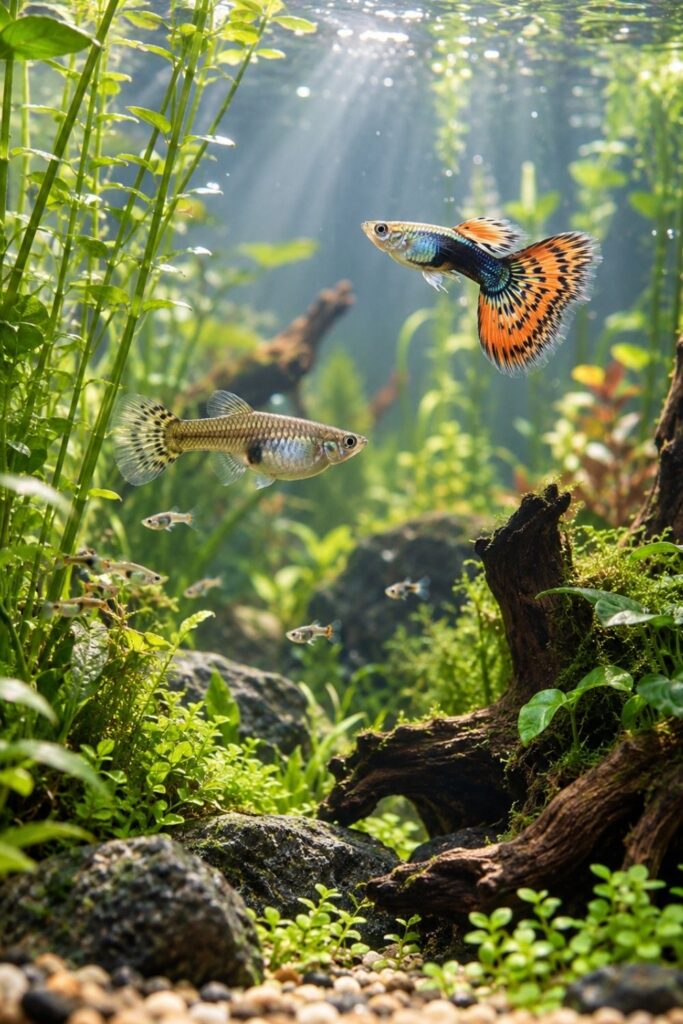
Guppies in the aquarium (illustrative image)
Tank mates and compatibility: What other fish can they live with?
A balanced community aquarium is a delicate ecosystem where every species needs to fill its role without bothering the other inhabitants too much.
Guppies are inherently peaceful, calm, curious, and very sociable fish, but their unique body shape, especially the long, showy tails on the males, along with their activity level, means you need to choose their daily tank mates very carefully.
Good community tank mates
- Corydoras: these friendly, peaceful bottom-dwellers spend their time cleaning up leftover food that falls to the substrate, going completely unnoticed by the guppies and coexisting in perfect harmony.
- Small tetras: fish like neon tetras and similar species tend to share the space beautifully, as long as the tank has enough gallons for everyone.
- Mollies and platies: since they belong to the same large livebearer family (Poeciliidae), they share very similar water chemistry requirements, though you’ll always need to keep an eye on total tank volume to avoid overcrowding.
- Ornamental freshwater snails: species like Neritina snails or Planorbis actively help control algae buildup on the glass and add biodiversity without bothering anyone.
Tank mates you should avoid at all costs
- Fish known for fin-nipping behavior: species like Buenos Aires tetras or certain active barbs, such as the tiger barb, have the annoying habit of constantly nipping at the long tails of male guppies, leaving them stressed and highly vulnerable to secondary infections.
- Large or aggressive cichlids: any medium-to-large fish that sees a guppy as an easy snack is automatically off the list for this type of tank.
Health and common guppy diseases
Despite being rightfully considered hardy and adaptable fish, guppies can get sick fairly easily if water quality deteriorates consistently, or if they experience ongoing episodes of environmental stress.
Knowing the early warning signs makes all the difference between saving your fish in time or losing it.
Ich (white spot disease)
This is the most well-known disease in the general fishkeeping world. It’s caused by a microscopic parasite that makes the fish’s body look like it’s been sprinkled with tiny grains of salt.
It usually appears suddenly after sharp temperature drops in the room or when new fish are added to the tank without going through quarantine first.
It’s treated with specific medications available at specialty stores, combined with a slight and controlled increase in water temperature to speed up the parasite’s life cycle.
Fin rot
If you notice that the males’ showy, delicate tails are starting to fray around the edges, turning opaque, or showing whitish or blackish tips, you’re dealing with a bacterial infection that usually stems from poor accumulated water quality, like excess ammonia or high nitrate levels.
The main solution is performing regular partial water changes, improving filtration, and applying antibacterial treatments if the infection progresses.
Columnaris disease
This bacterial illness typically shows up as whitish patches along the back or around the mouth, causing the fish to swim erratically or stay motionless at the surface.
It’s a fast-moving infection that requires urgent action: correcting the water parameters and using the appropriate medications.
Conservation and responsible home ownership
Even though we’re talking about fish that live in an artificial environment inside our homes, caring for a guppy means taking on an unavoidable ethical responsibility toward a living being that feels and depends on us.
Truly responsible fishkeeping always begins with understanding that an aquarium is not just a static decorative item, but a small piece of nature under our care.
The golden rule: never release fish into the wild
One very serious mistake that sometimes happens, driven by uncontrolled breeding that overwhelms the tank, is releasing extra guppies into local ponds, rivers, irrigation channels, or public fountains.
This can cause devastating ecological damage. As we mentioned at the beginning when discussing their history, the guppy is an extremely hardy and prolific species capable of displacing native aquatic wildlife, competing fiercely for available resources, and completely disrupting the fragile balance of local ecosystems.
If you find yourself with too many guppies at home and they no longer fit, the right and ethical thing to do is give them away to other hobbyists in your area, talk to trusted local fish stores about taking them in, or plan ahead by separating males and females in your tanks.
Day-to-day animal welfare
Sticking to a consistent cleaning routine, changing an appropriate percentage of water each week, making sure every fish is eating properly, and watching their daily behavior are simple but vital actions that guarantee a dignified and long life for your fish.
A well-cared-for guppy in an optimal environment can easily live between two and three years, rewarding you with all its color and energy.
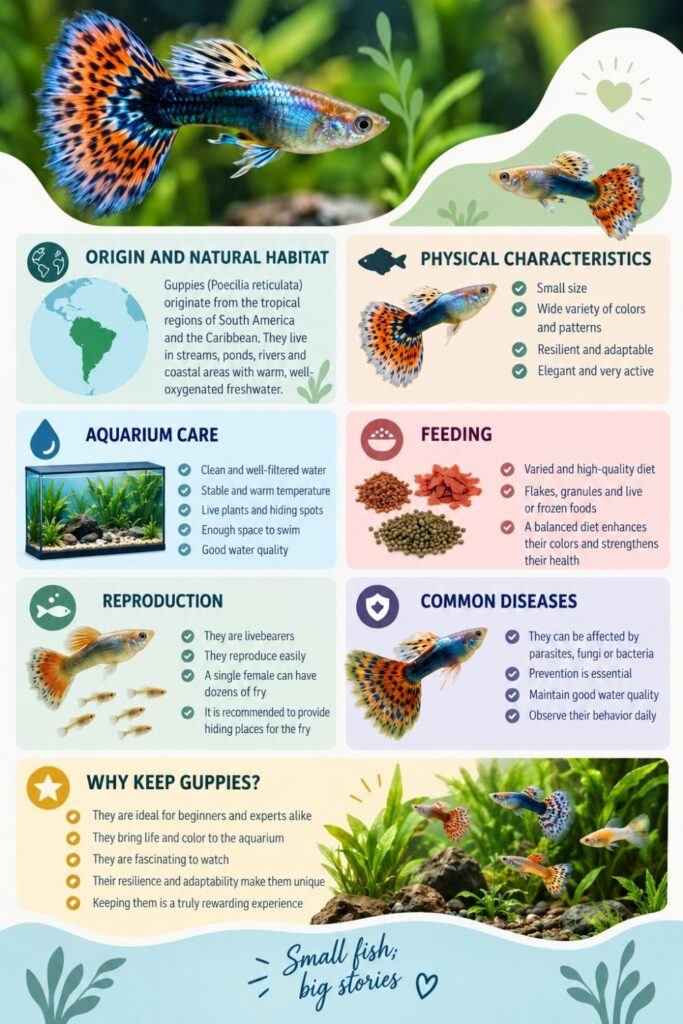
Guppy infographic
Frequently asked questions about guppies
How many guppies should I keep together in a tank for them to be happy?
Ideally, you should always start with a minimum group of four or five fish so they don’t feel stressed. It’s also very important to maintain a proper ratio between sexes: the most commonly recommended practice is to keep at least two or three females for every male. This prevents the males from constantly harassing and exhausting a single female with their persistent courtship attempts.
Why are my guppies staying still in a corner or floating at the surface?
This behavior is usually a clear sign that something is off with the water chemistry. The first thing you should do is immediately test for ammonia, nitrites, and pH levels.
A buildup of organic waste or a noticeable lack of dissolved oxygen causes fish to desperately gasp at the surface or sit listlessly in a corner. A partial water change usually helps relieve the situation.
Can you crossbreed different color varieties of guppies?
Yes, biologically they all belong to the same species, so they’ll breed with each other without any issues if they share the same tank.
However, keep in mind that if you cross varieties with very different color patterns or tail shapes, future generations will gradually lose their standardized selectively bred traits and you’ll end up with more wild-looking or varied fish.
Do I need live plants in a guppy tank?
It’s not strictly required for basic immediate survival, but it’s a very strong recommendation. Live plants help oxygenate the water, consume harmful nitrates, serve as an essential refuge for females when they need to escape male harassment, and provide the perfect hiding spots for fry to survive after birth.
What should I do if I have too many fry and my tank is completely full?
It’s the natural biological consequence of keeping guppies at home. When you reach that predictable point, the best solution is to permanently separate males from females in different tanks if you don’t want to keep dealing with endless broods, or find new homes for them among friends, acquaintances, or local fish stores willing to take them in.
Taking care of a group of guppies is one of those relaxing hobbies that grabs you slowly but firmly. Watching them swim with their nonstop energy, suddenly spotting a tiny fry peeking out shyly from behind the leaves, or seeing how the tank takes on a life of its own is an incredibly rewarding feeling.
If you follow these basic maintenance steps, respect the water’s timing, and give them a balanced home, I promise you’ll enjoy this little ecosystem for a very long time.
I’d love to hear about your experience so far.
Are you thinking about setting up your first guppy tank, or do you already have one at home keeping you busy?
Drop me a comment below and let’s chat about it.