Everything you need to know about neon tetras. Tank setup, feeding, breeding, health, and care tips for beginners and experienced hobbyists alike. Dive in and learn how to keep them happy!
Have you ever stared at a tank and felt like something was missing, like the fish were just floating decorations with no real life to them? That’s exactly what happened to me during my first few months in the fishkeeping hobby.
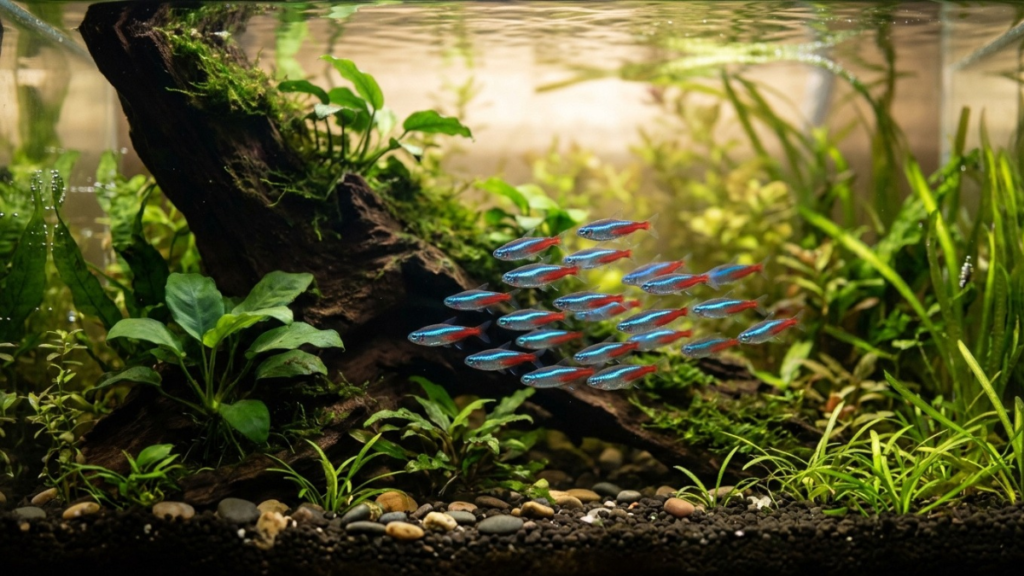
I had a planted tank that looked nice enough, but it felt flat. Then one day, a friend gave me a single neon tetra. The moment I released it into the water, everything changed. That flash of electric blue cutting through the green of the plants, combined with the intense red on its body, completely transformed the energy of that little corner.
Since then, the neon tetra has become one of my absolute favorite fish and, without question, one of the biggest stars of freshwater aquariums worldwide. Over the years I’ve made mistakes, learned from them, adjusted my routines, and figured out what these little swimmers truly need to live happy and healthy for years.
If you want to discover all the secrets behind this fascinating fish, grab a drink and stick with me. We’re going to cover everything you need to know, from their origins in the rivers of South America to every last detail about how to build their perfect home, how to feed them right, how to prevent diseases, and how to understand their everyday behavior.
This post contains affiliate links. See the full disclaimer.
Origin and natural habitat
To take proper care of any animal, the first and most important thing is understanding where it comes from. The neon tetra, whose scientific name is Paracheirodon innesi, didn’t just appear out of thin air in a pet store. Its natural history tells us a lot about what we need to replicate at home so it feels like it belongs.
The dark waters and rivers of the Amazon basin
This tiny fish is native to South America, specifically the tributaries of the Solimões River in the Amazon basin, stretching across areas of southeastern Colombia, eastern Peru, and western Brazil. Unlike what many people picture, the water in these rivers isn’t crystal clear like a well-maintained swimming pool. It’s actually the opposite. These are usually so-called blackwaters, though neon tetras also inhabit clear-water streams.
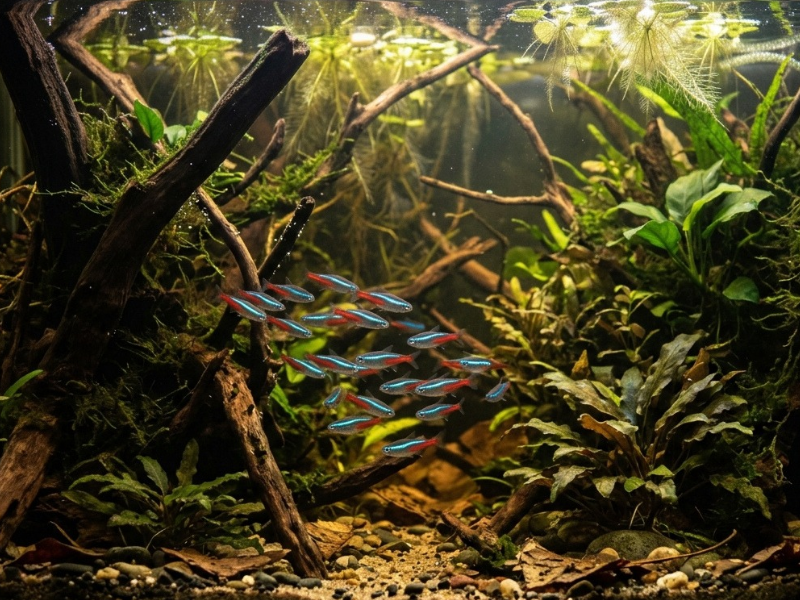
These are waterways that flow beneath dense tropical rainforests. The riverbed is covered in a thick layer of fallen leaves, branches, and decaying roots. As all that plant material breaks down, it releases tannins and humic acids that stain the water an amber or translucent brown, very similar to the color of strong tea. This natural decomposition makes the water extraordinarily soft and markedly acidic, with pH values that can drop to between 4.0 and 4.8 in the wild.
Light filtered through the jungle canopy
Picture the density of the Amazon rainforest. The trees grow so tall and their canopies intertwine so tightly that sunlight barely reaches the water’s surface, coming through only as faint, diffused rays. Because of this, neon tetras are adapted to living in dim conditions. In fact, when you set up a home aquarium with overpowered lighting and no shaded areas, the fish tend to get stressed, lose the intensity of their colors, or hide among the plants.
Temperature and gentle currents
The climate in their natural habitat is warm year-round. Water temperature typically ranges between 68°F and 79°F. The currents in the streams and tributaries where they live tend to be slow to moderate, allowing them to swim in a school without much effort.
Understanding this environment gives us the ultimate blueprint. Replicating these conditions in our tank is a biological necessity for their immune system to function properly and for their lifespan to reach its full potential.
Anatomy and physical features. That glow you can’t look away from
At first glance, the neon tetra is unmistakable. Its body looks like the work of a minimalist artist playing with nature’s contrasts. But have you ever wondered why they glow so brightly?
The glowing stripe and smart camouflage
The most striking feature of this fish is the horizontal line of electric blue or brilliant greenish-blue that runs from its eye all the way to its adipose fin. Just below that stripe, the back half of its body displays a red so intense it looks like it’s lit from within.
In the wild, the murky, dark waters make visibility a challenge. That luminous stripe acts like a beacon so members of the school can find each other when visibility is low or when a potential predator approaches.
It’s an incredibly effective visual communication tool. In fact, when you turn off the aquarium light at night, their reflective cells change and lose their intensity. Neon tetras need sleep too, and they dim their glow to camouflage themselves in the darkness of night.
Size and general body shape
These are truly tiny fish. Their standard length (not counting the tail fin) is around 1 to 1.2 inches, reaching about 1.4 inches total with the tail included. Their body is elongated, laterally compressed, and features a small adipose fin between the dorsal and caudal fins, a typical trait of the characin family.
Their mouth is small and adapted for feeding on tiny organisms suspended in the water or at the surface. Their eyes are large relative to their head, which indicates they have strong visual capabilities adapted to the low light of their environment.
Telling males from females
Unlike some species where it’s incredibly easy to tell the sexes apart, with neon tetras this can be a real challenge, especially when they’re young.
- Females tend to be slightly more robust and rounder, especially when they’re gravid (full of eggs). If you look at them from above, their profile is wider. The bright blue stripe also tends to show a slight curve because of their rounder belly.
- Males are a bit more slender, thinner, and smaller. The blue stripe on a male’s body is usually perfectly straight.
That said, unless you’re planning to try breeding them in captivity with mature adults, these subtle differences barely matter for day-to-day life in a community tank.
Social behavior. Why you should never keep just one
Neon tetras are schooling fish
If you ever see a neon tetra swimming completely alone in a display tank, you can tell something’s off. It looks washed out, nervous, hiding in a corner, or swimming up and down erratically.
The neon tetra is a social animal by nature. Its survival instinct depends entirely on the group. In the wild, forming large schools confuses predators. When a bigger fish tries to attack, it sees a confusing mass of flashing blues and reds in motion rather than a single clear target.
What’s the minimum number to keep?
The general rule for this species is to keep a group of at least 8 to 10. Personally, I always recommend aiming for 12 to 15 if the size of your tank allows it. In a large group, the fish feel safe, display their natural hierarchies, swim in formation through the middle of the tank, and show off much more vivid and vibrant colors.
Getting along with other species
Since they’re peaceful, calm, and small, neon tetras make ideal companions for a freshwater community tank, as long as you pick the right neighbors.
- Good tank mates include corydoras on the bottom, small plecos like bristlenose plecos, other peaceful tetras (like lemon tetras in the right proportions), rasboras, pencilfish, and peaceful gouramis or dwarf gouramis.
- Bad tank mates include large or predatory fish like big cichlids or adult angelfish in smaller tanks (while angelfish can sometimes coexist with neons, the risk is always there if the neons are small enough to fit in their mouths), and hyperactive or fin-nipping species like certain barbs (tiger barbs are the classic mistake here, since they’ll constantly nip at your neons’ fins).
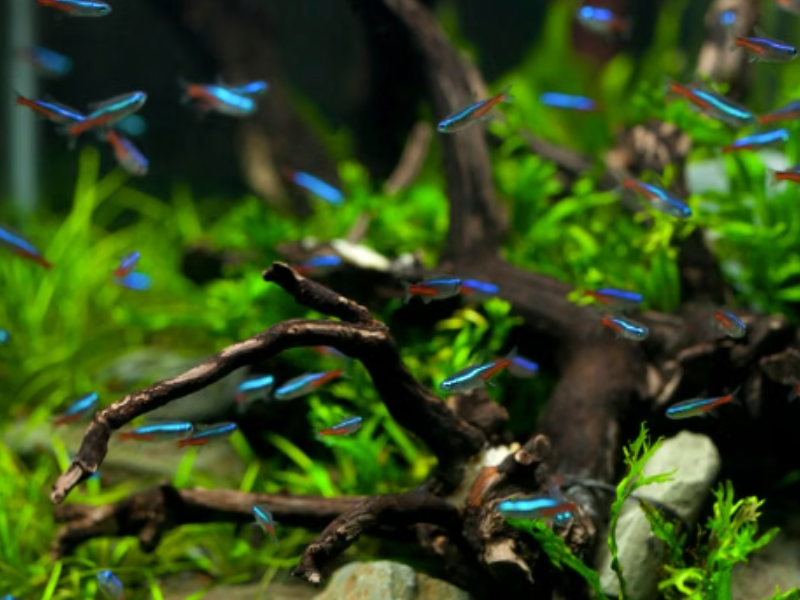
The ideal tank setup step by step. Building their perfect home
Setting up a tank designed to make neon tetras feel right at home takes some planning and attention to the basics.
Tank size
To keep a proper school of 10 to 12 along with a few bottom dwellers, the minimum recommended size is around a 15-gallon tank. Anything smaller limits their swimming space too much and causes water parameters to fluctuate too quickly, which is dangerous for their health. If you can go with a 20 or 25-gallon tank, the ecosystem will be much more stable and your fish will thank you for it.
Filtration and water flow
They need a filter that moves water efficiently (about 4 to 5 times the total tank volume per hour), but without creating strong currents that push them around. A properly adjusted hang-on-back filter or an internal filter with a diffused output works great. Remember to place a sponge or pre-filter over the intake if your tetras are very small, so they don’t get sucked in.
Ideal water parameters
- Temperature. Between 72°F and 79°F is the ideal range. The sweet spot sits right around 75°F.
- pH. Slightly acidic, ideally between 6.0 and 7.0. If your tap water runs very alkaline (pH 8), you can use reverse osmosis water mixed with tap water or add peat to your filter to naturally lower the pH.
- Hardness (GH and KH). Soft to very soft water (GH below 10 dGH).
Setting the scene. Live plants, driftwood, and shadows
If you want to see the best color display from your neons, fill your tank with natural elements.
- Live plants. Place dense stem plants along the back and sides (like Egeria densa, Cabomba, or various types of Ludwigia), and leave an open area in the center for them to swim together as a school. Floating plants (Salvinia or Limnobium laevigatum) are wonderful because they filter the light coming from above, creating that shaded jungle effect they love so much.
- Driftwood and roots. These add texture, shelter, and release those beneficial tannins that are great for their skin and mucous membranes.
- Dark substrate. A dark-toned substrate and gravel (dark brown or black) intensifies the contrast of their colors and prevents them from getting spooked by light reflecting off the bottom.
What to feed them for health and vibrant color
Feeding your neon tetras well is one of the core pillars of keeping that dazzling color and rock-solid health. In the wild, they’re omnivorous opportunists that eat small crustaceans, insect larvae, aquatic worms, and bits of organic matter floating in the current. In the aquarium, we need to offer them a diet that’s just as varied and nutritious.
The daily staple. Flakes and ultra-fine pellets
Commercial dry food is going to be the backbone of their daily diet. However, neon tetras have truly tiny mouths and throats.
- Flake food. If you’re giving them regular community fish flakes, make sure to crush them between your fingers before dropping them in the water. If a flake is too big, they’ll try to bite it, it’ll fall to the bottom, and it’ll end up rotting in the substrate.
- Slow-sinking micro pellets. This is, in my opinion, the best option. Micro pellets designed specifically for small fish or tetras float for a few seconds and then slowly sink through the water column, letting your fish catch their food mid-fall, which is exactly how they like it.
Always look for high-quality commercial foods where the main ingredient is actual fish meal or seafood, not cereal fillers or grain-based substitutes.
The magic touch. Live and frozen foods
If you want to see your school of neons unleash their hunting instincts and display the most intense reds and blues imaginable, you need to include live or frozen foods in their weekly menu (a couple of times a week is ideal).
- Brine shrimp (freshly hatched or small adults). They absolutely love these. Brine shrimp provide a massive amount of protein and natural pigments that enhance their body color.
- Daphnia (water fleas). Great for digestion since they act as natural fiber and help prevent intestinal problems.
- Bloodworms and white mosquito larvae. Very nutritious, though you should feed bloodworms in moderation (once a week at most) because of their high fat content.
- Grindal worms or microworms. Excellent if you want to give them an extra caloric boost or if you’re conditioning a group for breeding.
The two-minute rule and feeding frequency
A super common mistake when you’re starting out is dumping in too much food “so they don’t go hungry.” The rule is simple. Only give them the amount they can finish completely in under two minutes.
It’s much better to feed them twice a day in small amounts than to give them a mountain of food in one sitting. Anything that sinks to the bottom and isn’t eaten within a few minutes turns into ammonia and nitrites, contaminating the water and putting the health of your entire tank at risk.
How to spot and treat the most common diseases
Neon tetras are relatively hardy fish when we keep water quality within the right parameters, but because they’re so small, when they do get sick you need to act fast.
Daily observation during feeding is your best tool for catching any problem early.
The dreaded neon tetra disease (Microsporidia)
This is the nightmare of anyone who keeps neons. It’s caused by a microsporidian parasite called Pleistophora hyphessobryconis, an obligate intracellular organism that infects the fish’s skeletal muscles.
- Clear symptoms. The fish starts losing color (the blue stripe and the red fade to a washed-out, whitish appearance), it separates from the school, swims erratically or at an angle, and its spine may become visibly deformed.
- Treatment and prevention. Unfortunately, there is no effective cure for this parasitic disease at this time. The microsporidian spores are extremely resistant and can remain infectious in the water for months. If you identify a fish with these clear symptoms, the most responsible step is to isolate it immediately in a hospital tank to prevent the rest of the school from getting infected (the infection spreads when other fish nibble on a dead or sick companion and ingest the spores). The best medicine is prevention. Buy fish from reputable stores and quarantine all new additions.
A quick note. There’s also something called “false neon tetra disease,” caused by the bacterium Flavobacterium columnare (columnaris), which presents very similar initial symptoms. Unlike true NTD, since it’s a bacterial infection, it can be treated with antibacterials. However, effectiveness depends largely on correctly identifying the bacterium, its sensitivity to the available antimicrobials, and how far the infection has progressed. Infections caught early and localized to the skin and gills have a better prognosis than systemic ones. It’s recommended to isolate the affected fish in a hospital tank and, if possible, consult with a veterinarian who specializes in fish.
Ich (Ichthyophthirius multifiliis)
This one is much more common and easier to deal with if you catch it early. It usually shows up after a sudden temperature drop or stress from a poorly executed water change.
- Symptoms. Tiny white dots (like someone sprinkled grains of salt on them) scattered across the fins and body. The fish will often rub against plants or driftwood.
- Treatment. The main approach involves applying a specific commercial medication based on malachite green or methylene blue, following the manufacturer’s instructions. As a complementary measure, gradually raise the tank temperature to 82-86°F to speed up the parasite’s life cycle so it reaches the free-swimming stage faster (the only stage vulnerable to treatment).
- That said, raising the temperature alone isn’t enough to guarantee the infection is eliminated, since heat-tolerant strains exist. It’s important to increase oxygenation during treatment, because warmer water holds less dissolved oxygen.
Fungal infections and fin rot
These are two types of infections that are often confused but have very different causes and treatments.
- Fin rot (bacterial infection). The edges of the fins appear ragged, eroded, or with a whitish border, sometimes with redness at the base. It’s caused by opportunistic bacteria (like Aeromonas, Pseudomonas, or Flavobacterium) that take advantage of wounds, stress, or poor water quality to proliferate. It’s treated with aquarium-specific antibacterials.
- Fungal infections. These appear as cottony white or grayish masses on the skin, fins, or wounds. The most common genera are Saprolegnia and Achlya. They’re usually secondary infections that colonize tissue already damaged by a wound, a burn, or a previous bacterial infection. They’re treated with specific antifungals (malachite green, methylene blue).
It’s crucial to distinguish between the two, since an antibacterial won’t eliminate a fungus and vice versa. When in doubt, take a close look at the lesion. Ragged edges without cottony growth usually point to a bacterial cause, while formations that look like cotton indicate fungus. Both are prevented by maintaining good water quality with regular weekly partial water changes of 20-30%. Always consult a specialist if you’re unsure.
Tank maintenance
You don’t need to spend hours and hours maintaining the tank. With an organized weekly routine of about 20 minutes, you’ll keep your neons in enviable health for years.
Weekly water changes. The key to success
Aquarium water is a closed system. No matter how good your filter is, nitrates from the nitrogen cycle keep building up day after day.
- Do a partial water change of 20% to 30% every week.
- Always use a quality water conditioner/dechlorinator to remove chlorine and chloramines from your tap water before adding it to the tank.
- Try to make sure the new water is at a similar temperature to the tank water to avoid thermal shock that could weaken your fish’s immune system.
Cleaning the filter and substrate
- Gentle gravel vacuuming. During your water change, run the siphon over the exposed areas of the substrate to remove fish waste and uneaten food. Don’t aggressively stir up the bottom if you have a nutrient-rich substrate.
- Filter media cleaning. Clean the sponges and filter media only with water taken from the tank itself during a water change. Never use tap water directly, because the chlorine will kill the beneficial bacteria colony that’s keeping your water clean.
Breeding in captivity. The rewarding challenge for hobbyists
Breeding neon tetras at home isn’t as simple as breeding guppies or platies, but it’s a beautiful project that gives you enormous satisfaction if you’re up for trying it. It requires a dedicated breeding tank and patience.
Setting up the breeding tank
To succeed, you’ll need a separate tank of about 2.5 to 5 gallons that’s been carefully set up.
- Soft, acidic water parameters. pH between 5.0 and 6.0, and hardness (GH) close to zero (1-2 dGH). You can achieve this using 100% RO water or distilled water acidified with peat.
- Near-total darkness. Neon tetra eggs are light-sensitive, and direct light destroys them. Cover the glass with dark cardboard.
- A protective bottom layer. Place a mesh at the bottom or a very dense layer of Java moss. Neon tetras don’t care for their offspring. If they spot their own eggs on the bottom, they’ll eat them immediately. The mesh lets the eggs fall through to where the adults can’t reach them.
- Gentle filtration. Just a small sponge filter powered by an air pump, so it doesn’t suck up the fry.
Selecting the pair and spawning
Pick the plumpest, most mature female from the school and the most active male with the most vivid coloring. A week beforehand, feed them both plenty of live foods (brine shrimp or bloodworms).
Introduce the pair into the breeding tank in the evening. Spawning usually happens first thing the next morning. The male will swim around the female, encouraging her until she releases the eggs (anywhere from 60 to 300 transparent, adhesive eggs depending on the female’s maturity), which the male will fertilize instantly. First-time females tend to produce fewer eggs.
As soon as spawning is done, remove the parents immediately and return them to the main tank.
Caring for the fry
The eggs will hatch in about 24 to 36 hours, depending on water temperature. During the first 48 hours, the larvae will consume their yolk sac and won’t need any external food.
Once they start swimming freely and looking for food, you’ll need to feed the tiny fry with infusoria (protozoa) or liquid fry food specifically designed for newborns during the first few days. As they grow (starting around the first week), you can move them onto freshly hatched baby brine shrimp. Keep the breeding tank in dim light for the first two weeks to ensure optimal development.
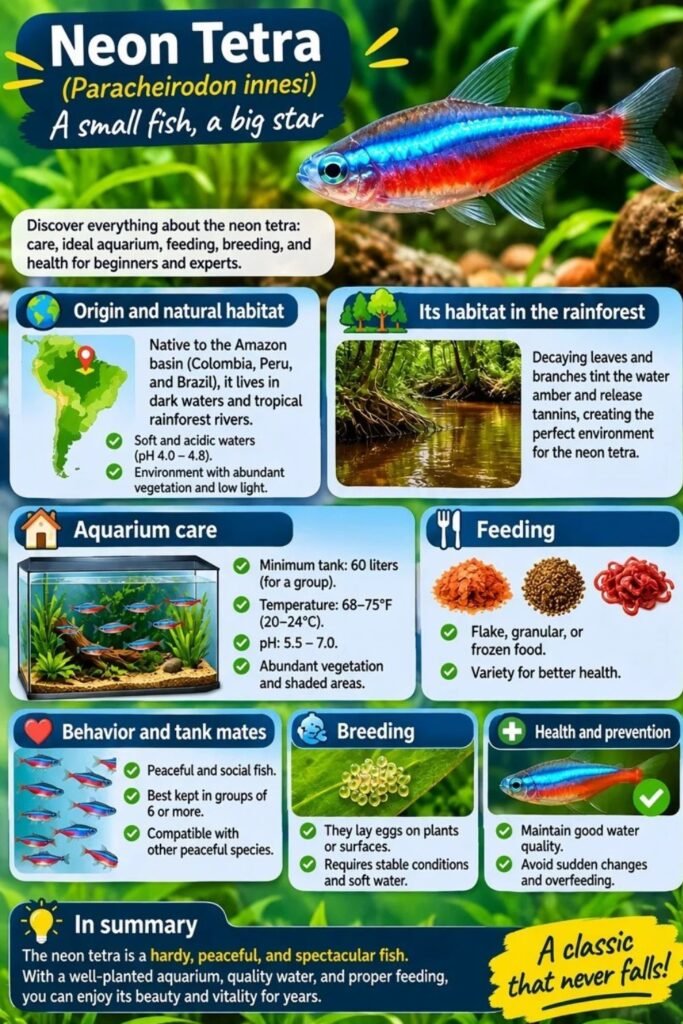
Neon tetra infographic
Frequently asked questions about neon tetras
How long do neon tetras usually live?
In a well-maintained tank with stable water parameters and good nutrition, a neon tetra can comfortably live between 5 and 8 years. Some sources mention numbers close to 10 years, though that’s not common and isn’t well documented for this species. In tanks with poor maintenance, their lifespan can drop to just 2 or 3 years.
Can neon tetras live with bettas?
It depends on the individual betta’s temperament and the size of the tank. In smaller tanks (under 10-13 gallons), it’s not recommended. In larger, well-planted tanks, they can coexist if the betta isn’t overly aggressive and the school of neons is large enough. One thing to watch for, though. Sometimes neons can be tempted to nip at the flashy fins of a long-finned betta if the school is too small.
What’s the difference between a neon tetra and a cardinal tetra?
They look incredibly alike, but there’s a super easy trick to tell them apart.
Neon Tetra (Paracheirodon innesi). The red stripe underneath only covers the back half of the body (from the belly to the tail). It’s a slightly smaller fish and tolerates somewhat cooler temperatures.
Cardinal Tetra (Paracheirodon axelrodi). The red stripe runs along the entire belly, from head to tail. It tends to grow a bit larger and prefers slightly warmer water (77-82°F).
Why do my neon tetras lose their color at night or when I turn on the light?
This is completely normal behavior. At night, to conserve energy and avoid being detected by predators in the darkness, they reduce the reflectivity of their pigment cells. When you turn on the tank light in the morning, it takes them about 15 to 30 minutes to get their dazzling glow back to full brightness. If they’re losing color during the day with the light on, that’s a sign of stress or illness.
Is it normal for them to chase each other all the time?
Yes, totally. Even though they’re very peaceful schooling fish toward other species, within the group itself there are small hierarchies at play. Males tend to have brief chases and little “showoff duels” where they flare their fins to establish their spot within the school. As long as they’re not causing injuries or relentlessly pursuing a weaker member to the point of exhaustion, it’s just part of their normal social behavior.
As you can see, the neon tetra is so much more than a pretty fish to fill up a tank. It’s a miniature window into the rivers of the Amazon rainforest. Keeping them healthy, watching them swim in a school, and enjoying their color is one of the most rewarding experiences freshwater fishkeeping has to offer.
With a properly sized tank, gentle filtration, live plants, and a simple but consistent care routine, you’ll have a living spectacle in your living room for many years to come.
Do you already have a school of neon tetras at home, or are you planning to set up your first tank for them? Do you still have questions about their water parameters or feeding?
I’d love to hear from you in the comments! Share your experience, drop your tips, or ask me anything you need. Together we make this fishkeeping community closer and more passionate.
If you want to learn more about different species and you’re just getting started in the aquarium hobby, check out our book Your First Aquarium!