Just getting into the aquarium hobby and not sure which fish to pick? Discover the best Fish Species for Beginners, their basic care needs, and how to build a healthy ecosystem from scratch. A complete, natural, no-nonsense guide. Make your first tank a success!
Hi there! I’m so glad you’re reading this. If you’ve landed here, it’s because you’re curious about having a little piece of river or lake in your living room, just like I was a while back. You have no idea what you’re getting into. This hobby is seriously addictive! Watching fish interact, plants grow, and nature find its balance in such a small space is simply magical.
Let’s be real, though. At the beginning it’s all questions. You walk into the store and see hundreds of colorful fish, each prettier than the last. The salesperson, with good intentions (or not), tells you “this one and this one are easy,” and you go home with a mix that turns into a disaster within two weeks. Dead fish, cloudy water, algae everywhere. It’s frustrating and genuinely sad, above all for the animals.
I’ve been there. I made every mistake in the book: too many fish, no cycling (don’t worry, I’ll explain what that means), overfeeding, incompatible species. That’s why I’m writing this guide. I want your first experience to go differently. I want you to set up a tank you’re proud of, where the fish live happy and healthy, and where you can relax watching it instead of stressing over it.
This post may contain affiliate links. If you buy through them, you support my work at no extra cost to you
The core idea: these aren’t furniture, they’re living creatures
Before we get into beginner fish species, I want to talk about something really important. An aquarium isn’t a painting. It isn’t just another piece of decor. It’s a living ecosystem. It’s a commitment. The same way you wouldn’t keep a dog shut in a bathroom its whole life, you can’t keep a fish in conditions that aren’t right for it.
This guide comes from a place of conservation and responsibility. The goal isn’t just for the fish to “survive.” It’s for them to thrive. To get there, we have to recreate the conditions of their natural habitat as closely as we can. Which brings us to the first secret of the aquarium hobby: the water.
Your fish live, breathe, and excrete in that water. If the water isn’t right, they won’t be either. So before picking a fish based on its color, we need to know what kind of water we have (usually tap water) and what kind of water that fish needs. Not all fish are the same: some need hard, alkaline water, others soft and acidic; some live at 68°F (20°C) and others at 82°F (28°C). Mixing species with opposite requirements is a death sentence for one of them.
Golden rule #1: cycling (patience really is a virtue)
If you take away only one thing from this entire guide, make it this: you can’t add fish on day one. Burn it into your memory. It’s the most common mistake and the one that kills the most fish.
The tank needs to mature. In nature, fish waste (ammonia) gets absorbed by plants and bacteria and converted into harmless substances. In a brand new aquarium, those beneficial bacteria don’t exist yet. If you add fish, ammonia builds up and poisons them within days. The water turns white and the fish rise to the surface gasping. It’s awful to watch.
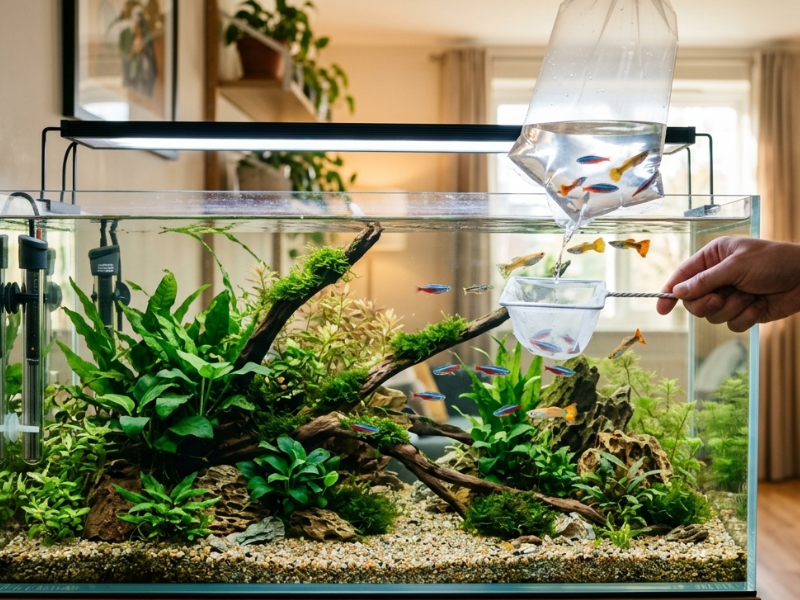
Cycling is the process of growing those bacteria in your filter. It takes 4 to 6 weeks. During that stretch, the tank will be “empty” of fish but full of microscopic life. You need to set the whole aquarium up (filter, heater, gravel, plants if you want them), fill it with water (dechlorinated, this part is essential), and “feed” the bacteria with a pinch of fish food every few days. With a water test kit, you’ll watch ammonia levels climb, then nitrite (also toxic), and finally nitrate (much less harmful). Once ammonia and nitrite both read zero, congratulations! Your aquarium is ready for its first residents.
What are we looking for in beginner fish?
For a fish to be a good fit for someone just starting out, it has to check three boxes:
- Hardiness: it can handle the small mistakes you’ll inevitably make (temperature swings, a late water change, the occasional overfeeding).
- Adaptability: it doesn’t need highly specific water parameters that are hard to maintain (like ultra-soft, acidic water requiring expensive equipment).
- Peaceful temperament: it gets along with other species and isn’t territorial or aggressive, so you can build a varied community tank.
Livebearers: color, energy, and lots of babies
If you want constant life and movement, livebearers are your best bet as beginner fish. They’re called that because they don’t lay eggs. The females give birth to fully formed fry that swim right away. In much of the country, tap water tends to be “hard” with a high pH, which suits them perfectly.
1. The guppy (Poecilia reticulata): the king of beginner fish
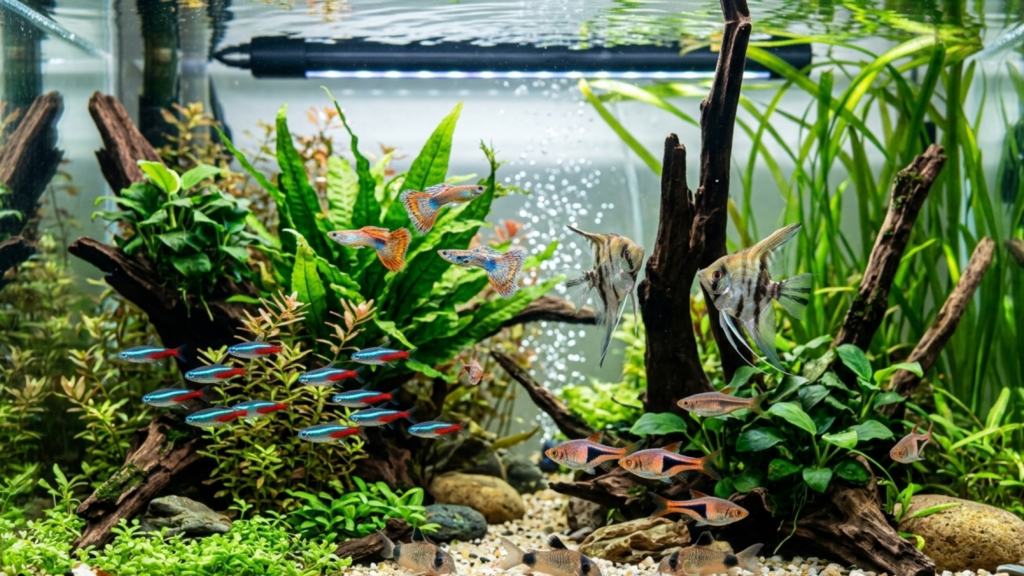
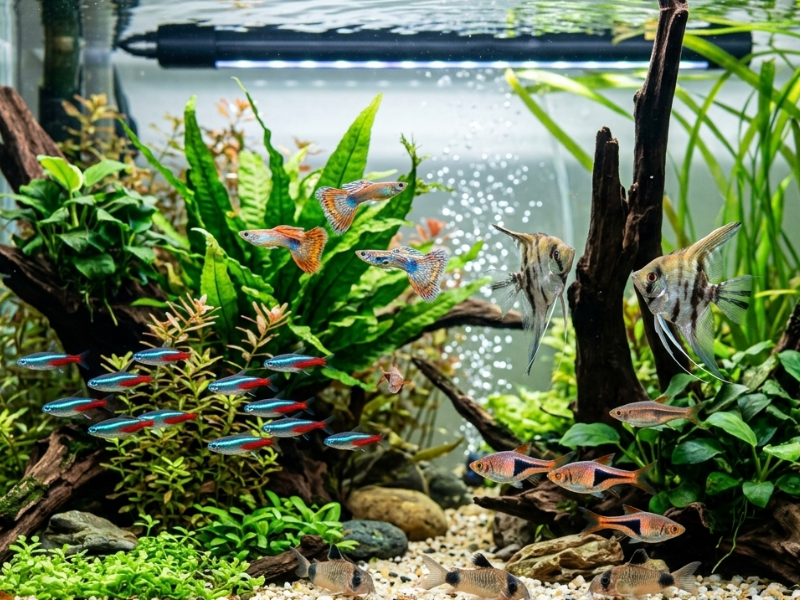
The guppy is probably the most famous fish in the world. Males have spectacular tails in every color imaginable: reds, blues, yellows, leopard-spotted patterns. They never stop moving.
- Why they’re great to start with: they’re tough as nails and forgive a lot of rookie errors. They’re also cheap and easy to find in any store.
- Basic care: they need water with a pH between 7.0 and 8.5 and a temperature around 75 to 79°F (24 to 26°C).
- Watch out for this: they breed at an absolutely wild pace. Put males and females together and your tank will be packed within two months. My advice if you’d rather avoid the hassle: keep males only. They’re prettier and they’ll live peacefully without stressing out the females.
2. The platy (Xiphophorus maculatus): the all-rounder
The platy is a stockier, rounder fish than the guppy. You’ll find them in bold solid colors like blood red, orange, or electric blue.
- Why choose one: they’re very peaceful fish that spend the day picking at algae growing on plants and rocks. They help keep the tank clean.
- Care: like guppies, they prefer hard water. They’re highly resistant to common diseases.
- Tip: pair them with live plants. The contrast of a red platy against green foliage is one of the prettiest things you’ll have in your living room.
3. The molly (Poecilia sphenops): elegance in black and white
Mollies run a bit larger than the previous two. The best known is the black molly, with its gorgeous velvety black finish. There are also white ones (balloon mollies) and dalmatian varieties.
- A curious detail: mollies love salt. If your water is very soft, they can get sick easily. In tanks with mollies, people sometimes add a little aquarium salt, though if your water is already hard, they’ll do just fine without it.
- Feeding: they need extra plant matter in their diet. Make sure to buy them a food that contains spirulina.
Tetras: the dance of the school
If you prefer something subtler and more elegant, tetras are for you. They’re schooling fish, and this part is critical: never buy a single tetra. They need to be with their own kind (6 to 8 individuals minimum) to feel secure. Alone, they get stressed, hide constantly, and eventually fall ill.
4. The neon tetra (Paracheirodon innesi): a glowing classic
The neon is that small fish with a brilliant blue stripe that looks lit from within, plus a red patch toward the tail. It’s every kid’s favorite.
- Ideal water: unlike livebearers, neons prefer softer, slightly acidic water (pH between 6 and 7). If your tap water runs soft, a neon will be in heaven.
- Care: they don’t like harsh lighting or abrupt water changes. They need a well-planted tank where they can hide when startled.
- Trick to make them pop: use a dark substrate. The neon’s blue will stand out far more than it would over white sand.
5. The rummy-nose tetra (Hemigrammus rhodostomus)
They get their name from the deep red coloring on their snout. The rest of the body is silver, and the tail is striped in black and white.
- Why I love them: they’re the best group swimmers out there. While other fish scatter, rummy-nose tetras tend to move as one unit, crossing the tank side to side. It’s hypnotic.
- Health indicators: they’re excellent early-warning systems. If the water goes bad or they’re stressed, the red on their faces fades. If their faces are bright red, you’re doing great.
The “cleanup crew”: your maintenance team (that doesn’t eat garbage)
Here’s a widespread misconception. We call corydoras and bristlenose plecos “cleaner fish,” and a lot of people assume you don’t need to feed them because “they eat the leftovers.” Completely wrong. They’re fish. They need their own food and their own care.
6. Corydoras: the charmers of the bottom
These are little whiskered catfish that spend the day rooting around in the sand. There are many species, but Corydoras aeneus (bronze) and paleatus (peppered) are the hardiest. Ideal beginner fish.
- The substrate is key: their whiskers (barbels) are extremely sensitive. Sharp-edged gravel or jagged stones will wear them down and lead to fatal infections. Always use fine sand or smooth, rounded gravel.
- Sociability: like tetras, they need to live in groups (5 minimum). It’s a blast watching them dart up to the surface together to gulp a bubble of air and head right back down.
7. Bristlenose pleco: the algae devourer
This is the fish that sticks to the glass with its suction-cup mouth. Unlike the common pleco (which grows to 2 feet and is a real problem for a newcomer), the bristlenose tops out around 5 to 6 inches, which makes it ideal for mid-sized tanks.
- Driftwood is mandatory: bristlenose plecos need cellulose to digest properly. You absolutely have to put a piece of natural driftwood in the tank. You’ll see it spend the whole day attached, rasping away at it.
- Specific food: buy sinking bottom wafers, preferably plant-based.
Feeding: don’t kill them with kindness
The biggest mistake we all make starting out is feeding too much. Fish always seem hungry, or at least they act like it. Every time you approach the glass, they come rushing over. But here’s the thing: a fish’s stomach is roughly the size of its eye. Feed them more than they need and whatever goes uneaten sinks, rots, and turns into poison (ammonia) for them.
The two-minute rule
Only add what they can finish in a couple of minutes. If you see food drifting to the bottom untouched, you’ve overdone it. Two or three tiny feedings a day beats one big one by a mile.
Variety means health
Don’t give them the same thing every day. If you ate nothing but cookies, you’d end up sick. Same goes for fish. Rotate quality flakes with sinking pellets and the occasional frozen food like brine shrimp or bloodworms.
Weekly maintenance for beginner fish: your success ritual
Plenty of people think cleaning an aquarium means emptying the whole thing and scrubbing the glass with soap. Never do that! Emptying the tank and deep-cleaning everything kills the good bacteria and restarts the cycle, which means dead fish.
Maintaining a healthy aquarium is far simpler:
1. The partial water change
Once a week, remove 20% to 25% of the tank water. Use a siphon (a tube that vacuums) to pull out the debris settled in the gravel. To refill, use tap water at the same temperature as the tank and, very importantly, add dechlorinator before it goes in. Chlorine is your filter’s number one enemy.
2. Glass and algae
If the glass starts turning green or brown, use a soft sponge (a new one that’s never touched soap) or a magnetic cleaner. A little algae is normal, so don’t obsess over it. But if you’re getting a lot, you’re either overfeeding or running the lights too long.
3. The filter (that great unknown)
Leave the filter alone most of the time. Only touch it when the flow drops noticeably. Then pull the sponges out and rinse them lightly, always in water you’ve just siphoned from the tank, never under the faucet. We want to remove the heavy gunk, not kill the bacteria living in there.
Keeping beginner fish healthy: how to catch problems early
At the end of the day, you know your fish better than anyone because you see them daily. If something looks off, act fast.
- Ich (white spot): looks like grains of salt scattered across the body. It usually appears after temperature swings. Treat it by raising the heater a few degrees along with a gentle medication.
- Frayed fins: could be from fighting or from poor water quality. Review your water change routine.
- Gasping at the surface: if every fish is up top trying to breathe, oxygen is low or you have a nitrite spike. Do a 50% water change immediately and make sure the filter is agitating the surface properly.
Frequently Asked Questions about first species for beginners
How long does an aquarium fish live?
It depends heavily on the species. A guppy usually lives about 2 years, while a neon tetra can reach 5, and a well-cared-for corydora can stick around for up to 10. It’s a long-term relationship.
Do fish get bored?
More than bored, they get stressed. They need an environment that stimulates them: live plants to hide in, driftwood to explore, and above all, companions of their own species. A lone fish in a bare tank is a sad fish.
Can I put a turtle in with my beginner fish?
Absolutely not. Turtles foul the water badly, need dry areas to climb out onto, and most importantly, they’ll eat your fish the moment they get the chance. Each belongs in its own setup.
How many fish fit in my aquarium?
Forget the “one inch of fish per gallon” rule, it’s far too imprecise. My advice: start with very few. In a 15-gallon tank, add 6 to 8 neons and 4 corydoras. See how it goes. If everything looks good after a month, you can add a couple more fish. Less really is healthier for them.
Enjoy the journey
Setting up an aquarium is one of the most rewarding things you can do. It teaches you to observe, to be patient, and to respect nature’s own timeline. Don’t beat yourself up if something goes wrong early on. Every one of us has lost a fish or battled an algae outbreak. What matters is that you don’t give up and that you learn from each step.
Having an aquarium means bringing a piece of life into your home. It’s about caring, observing, and above all, enjoying the calm it brings.
Which species caught your eye most for your first aquarium? Tell me below in the comments. I love hearing what projects you have in mind, and that way I can help you sort out compatibility before you buy anything. See you in the next post!