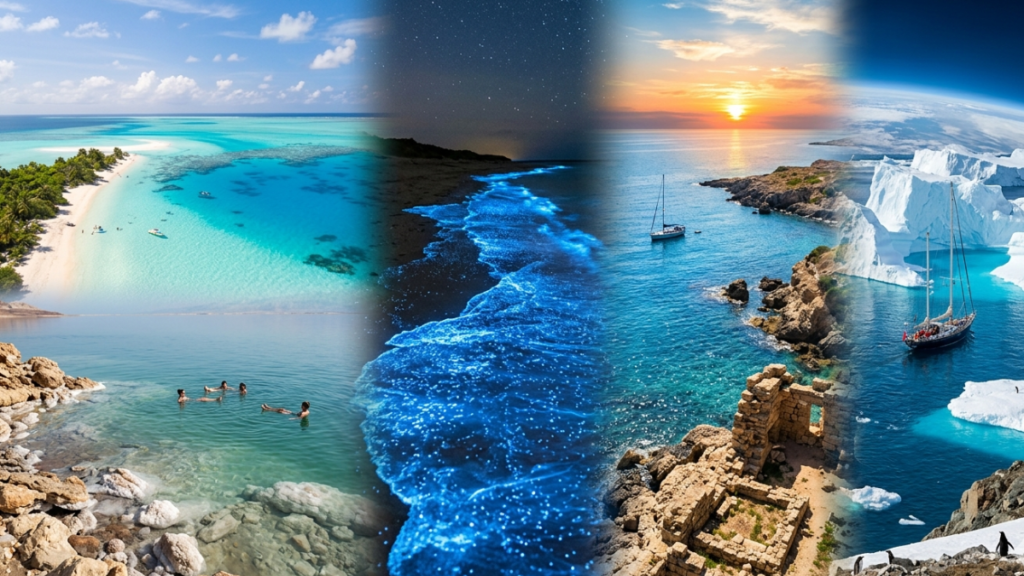
The world’s most fascinating seas, from the Dead Sea’s impossible salt to water that glows blue at midnight. Secrets, myths, and the strange science hiding under all that blue.
You know that feeling in your chest when you look out at the open water? The sense that something much bigger than you is happening down there. I get it every single time. One lungful of salt air and I’m gone. So I finally sat down and wrote the guide I’ve been meaning to write for ages.
We’re going from the glassy Caribbean to the darkest, most history-soaked corners of the Mediterranean, stopping at seas that glow after dark and one where sinking isn’t physically an option.
| Sea | Where | What makes it unique | Fun fact or myth |
| Dead Sea | Israel, Jordan, Palestine | Lowest point on Earth, 34% salinity. | You float without trying. Sodom and Gomorrah are said to lie on the bottom. |
| Sargasso Sea | North Atlantic Ocean | The only sea with no land borders, held in place by currents. | Where every eel on Earth spawns. Overlaps the Bermuda Triangle. |
| Ross Sea | Antarctica | The most untouched marine ecosystem left on the planet. | Home to Blood Falls, iron-rich brine that rusts on contact with air. |
| Caribbean Sea | Central and North America | Sits on its own tectonic plate, holds the second largest reef system. | Birthplace of piracy, with sunken Spanish galleons still down there. |
| Mediterranean Sea | Between Europe, Africa, Asia | An almost closed sea that hosted millennia of civilizations. | Nearly dried up 6 million years ago. Possible home of Atlantis. |
| Arabian Sea | Indian Ocean | The bridge between East and West, and wildly dynamic. | Milky seas, where the water glows electric blue at night. |
| Black Sea | Between Europe and Asia | The largest oxygen-free body of water in the world. | Preserves ancient shipwrecks intact. Possible origin of the flood myth. |
| Sulu Sea | Philippines | The heart of the Coral Triangle, staggering biodiversity. | Its maze of islands sheltered pirates for centuries. |
| Sea of Cortez | Mexico | Cousteau called it the aquarium of the world. | The only home of the vaquita. Gray whales approach the boats. |
| Coral Sea | Australia | Holds the largest living structure on Earth. | Visible from space, and sacred to Aboriginal Australians. |
1. The Dead Sea, where physics stops making sense
Starting strong. Technically this is an endorheic lake, not a sea at all, but nobody calls it that. Dead is also a stretch. The place is anything but. What it definitely is, though, is extreme.
How it got there
This is the lowest point on Earth, about 1,400 feet (430 meters) below sea level. Picture a scar torn across the planet’s crust, sitting between Israel, Jordan, and Palestine. It formed millions of years ago when the Rift Valley split open. It’s a leftover from prehistory that never went away.
Sodom and Gomorrah
You can’t talk about the Dead Sea without the legend. The ruins of the biblical cities, destroyed by fire and brimstone, are supposedly resting somewhere under all that heavy water. Locals will tell you that on very still days you can make out odd shapes on the bottom. Real, or the mind filling in blanks? Either way, it gives the place a shiver you don’t forget.
The part that’ll blow your mind: the salt
Here’s the fun part. Try to swim in the Dead Sea and you’ll end up bobbing around like a human buoy. Salinity sits around 34 percent, roughly ten times what you’d find in a normal ocean.
- Why you float: pure density. The water is so loaded with minerals (magnesium chloride, sodium, potassium) that your body weighs less than the water it pushes out of the way.
- What it does for your skin: the black mud isn’t just a prop for the photo with the newspaper. It has a global reputation for treating skin conditions and loosening up sore muscles. I’ve always thought of it as a giant spa that nature built by accident.
2. The Sargasso Sea, a floating desert with no shore
This one might be my favorite, because it’s the strangest sea on the map. Want to know why? It has no coastline. Anywhere.
A sea without banks
Exactly what it sounds like. Its edges aren’t beaches or cliffs, they’re four ocean currents circling around it (the North Atlantic Gyre). It’s an island made of water sitting inside the Atlantic. Eerily calm in the middle, ringed by furious current on every side.
The eel mystery
Where eels came from stumped everyone from Aristotle onward. Nobody could find a baby eel, ever. Then we figured out that every European and American eel alive swims thousands of miles to spawn right here. This is the nursery for all of them. Something about creatures crossing an ocean on an instinct we still don’t fully understand gets me every time.
Myths and the Bermuda Triangle
Part of the Sargasso overlaps the Bermuda Triangle, and old sailors were terrified of it. Columbus got tangled in the thick mats of sargassum weed on his first crossing and worried the ships would be stuck out there forever, going nowhere. Stories spread about graveyards of ships drifting in place for eternity.
3. The Ross Sea, the last frozen Eden
If anywhere on this planet still looks the way it always did, it’s here. The Ross Sea, down in Antarctica, is what a lot of scientists consider the most intact marine ecosystem left on Earth. A place where humans are finally just spectators.
A sanctuary at the edge of the world
Picture icebergs the size of small cities drifting through water so blue it’s almost unsettling. Adélie penguins, Weddell seals, orcas cutting through the surface. The place is packed with life in spite of the cold.
What gets me most is what it represents. In 2016 it was declared the largest Marine Protected Area in the world. That’s a promise about the future, a place where nature sets the rules and the rest of us watch respectfully from a distance.
Blood Falls
Not far from here, in the McMurdo Dry Valleys, there’s a glacier that appears to be bleeding. Deep red liquid pours straight out of the ice. For years people assumed red algae. The real answer turned out to be much better: it’s saltwater that got sealed under the ice two million years ago, with no light and no oxygen, loaded with iron. The second it hits open air, it rusts. Chemistry, on the most dramatic stage imaginable.
4. The Caribbean, and everything the postcards leave out
The Caribbean. You’re already picturing white sand and palm trees, I know. But this sea has a historical and biological depth to it that would knock you flat. It’s a collision of cultures sitting on top of an underwater engine room.
Where the name comes from
It’s named for the Carib people, who lived across the region when Europeans showed up. European accounts painted them as fearsome warriors, and out of that came centuries of stories about giants and sea creatures guarding these islands. Myths aside, the Caribbean sits on its own tectonic plate, which is why the volcanoes are where they are and why the islands look the way they do.
The Mesoamerican Reef
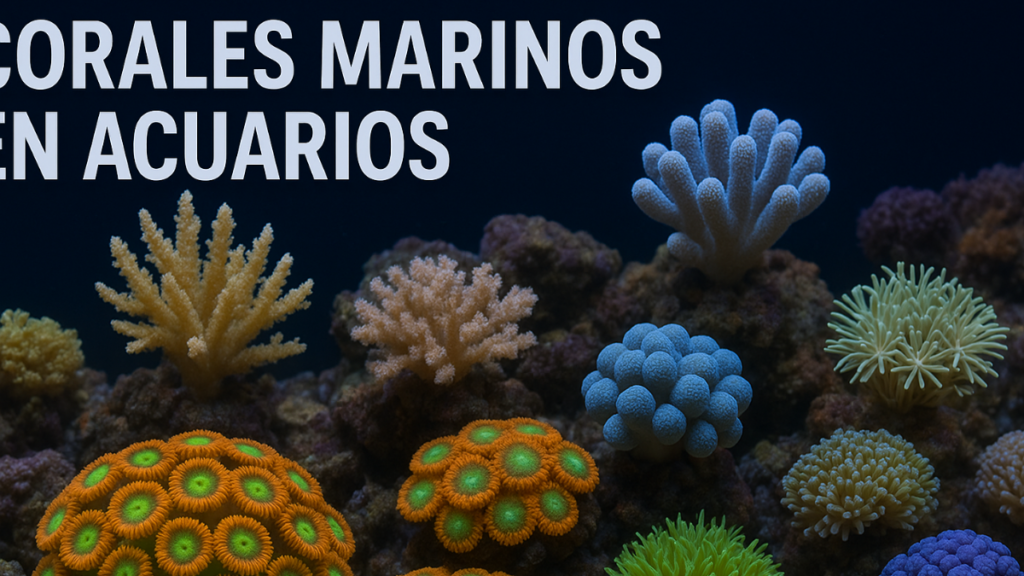
People forget the Caribbean holds the Mesoamerican Barrier Reef, the second largest coral reef system on the planet. It’s a maze of color running for hundreds of miles, with thousands of species living in it.
- Worth knowing: coral isn’t rock. It’s an animal, it’s alive, and it’s in trouble. Chemical sunscreen does real damage to it. If you’re going to swim there, go reef-safe. Small thing, big difference.
Pirates and sunken treasure
No talking about the Caribbean without the golden age of piracy, and no, it isn’t all Disney. Hundreds of Spanish galleons loaded with gold and silver went down here and never made it home. Plenty of that is still on the bottom, guarded (so the story goes) by the ghosts of the crews who went down with them in the hurricanes.
5. The Mediterranean, the blue heart of our history
Mare Nostrum. It’s a strange thing to sit with: an almost completely landlocked sea somehow became the stage for the most consequential civilizations humanity has produced.
Atlantis
A lot of theories put Atlantis somewhere in the Mediterranean, or just past the Strait of Gibraltar, the old Pillars of Hercules. Plato described an advanced civilization that vanished under the water in a single day and night of catastrophe. Stand on Santorini, which is essentially the leftovers of a volcanic explosion, and the myth starts to feel like it might be built on something that actually happened.
The time it almost dried up
Roughly 6 million years ago the Mediterranean nearly evaporated completely. Geologists call it the Messinian Salinity Crisis. The Strait of Gibraltar sealed shut and the whole thing turned into an enormous salt basin. Try picturing yourself walking across ground that’s now under a cruise ship. Eventually the Atlantic broke through and refilled it in one of the largest floods in the planet’s history. I’d have paid to watch that.
Salt, seagrass, and everything else
The Mediterranean is saltier than the Atlantic because more water evaporates off it than the rivers put back in. That’s where sea salt comes from, and it’s been feeding this region for thousands of years. Then there’s Posidonia oceanica, the meadows carpeting the seafloor. Not algae, but a flowering plant, and the reason the water runs so clear. Think of them as the rainforests of the Mediterranean.
6. The Arabian Sea, where the water glows
Ever wanted to swim through stars? The Arabian Sea is one of the most dynamic stretches of the Indian Ocean, and it hides a phenomenon that burns itself into your memory the first time you see it.
Milky seas
You’re in a boat in the middle of the night. The water is pitch black. Then you dip an oar in and the whole surface erupts in electric blue sparks. Not magic, just life. This is bioluminescence, mostly produced by a type of plankton called dinoflagellates.
- Why they light up: it’s self-defense. When something disturbs the water (a fish, a hull, your hand), they flash to startle whatever’s coming, or to call in something bigger that might eat their attacker. A biological alarm system, basically.
- How sailors read it: Arab navigators once took the glow for reflections off underwater cities, or spirits lighting the way along the spice routes. Science and folklore shaking hands under a full moon.
The oldest trade route in the world
This sea has always been the bridge between East and West. The maritime Silk Road ran straight through it. Frankincense, myrrh, and fine cloth all crossed this water. Empires rose and collapsed on these shores, and you can still feel that traffic in the ports today.
7. The Black Sea, a giant with two faces
Fascinating and slightly unnerving in equal measure. The name has nothing to do with the color of the water. It comes from a chemical quirk that makes this sea unlike any other.
A sea with no oxygen
Here’s the wild part. The Black Sea is the largest anoxic basin on Earth. Past roughly 500 to 650 feet (150 to 200 meters), the oxygen simply runs out. Nothing lives down there except a handful of very specialized bacteria.
- The perfect graveyard: no oxygen means no decay. Which turns the floor of the Black Sea into the best archaeological museum on the planet. Byzantine and Roman ships have been found down there almost untouched, the wood still solid, looking like they sank last week. A time capsule in the truest sense.
The flood myth
There’s a theory a lot of geologists find compelling: that the Black Sea started as a much smaller freshwater lake. When the last ice age ended, the Mediterranean rose high enough to burst through the Bosphorus and pour in with staggering force, a waterfall hundreds of times bigger than Niagara. That single catastrophe may be the seed of the great flood story that shows up in culture after culture.
8. The Sulu Sea, a coral maze in the Philippines
Where the Black Sea is darkness and mystery, the Sulu Sea is the opposite: pure color, pure noise, pure life. This is the heart of the Coral Triangle.
Tubbataha Reefs
Sitting out in the middle of this sea is Tubbataha, a UNESCO World Heritage atoll so remote you can only visit a few months out of the year. The biodiversity is overwhelming. Whale sharks, manta rays, sea turtles, and coral walls that drop straight off into the dark. Life showing off.
Pirates, then and now
The Sulu Sea has always carried a dangerous reputation. Thousands of tiny islands and mangrove channels made it a perfect hideout for Southeast Asian pirates for centuries. Even today, large parts of it are hard to reach and nature is still calling the shots.
Conservation, because none of this is guaranteed
I can’t keep listing wonders without getting serious for a minute. The ocean hands us everything. Half the oxygen you’re breathing right now came from the sea, not from trees. It regulates the climate and it feeds billions of people. And it’s struggling.
What’s going wrong
- Plastic. The garbage patches you hear about aren’t tidy floating islands, they’re clouds of microplastic that work their way up the food chain and end up on your plate.
- Warming. Coral bleaches when the water gets too hot, and bleached coral is dying coral. Lose the reefs and you lose the ocean’s nursery.
- Overfishing. We’re taking out more than the sea can put back.
What you can actually do about it
Nobody’s asking you to chain yourself to a trawler. Small habits stack up:
- Cut back on single-use plastic. Bottles and straws are the easy wins.
- Buy seafood from sustainable sources.
- Back marine protected areas when they come up for a vote.
- Talk about it. People protect what they love, so share the good stuff.
9. The Sea of Cortez, the aquarium of the world
No list is complete without this stretch of water between the Baja peninsula and mainland Mexico. Jacques Cousteau himself called it the aquarium of the world, and he wasn’t exaggerating even slightly.
A sea that’s still being built
The Sea of Cortez is young, geologically speaking. It formed as the San Andreas fault system pried the peninsula away from the rest of the continent, and that’s still happening. The whole place is geologically restless.
Vaquitas and gray whales
This is the only place on Earth where the vaquita lives, or rather tries to. It’s the smallest porpoise in the world and the most endangered marine mammal we have. The same water also hosts one of nature’s great shows: the gray whale and blue whale migrations.
- The part people don’t believe: the gray whales here are famously curious about people. They’ll come right up alongside a small boat, close enough to touch. Ask anyone who’s done it. It rearranges something in you.
10. The Coral Sea, Australia’s great blue lung
For sheer scale, nothing touches the Coral Sea. This is where life dresses up.
A living thing you can see from orbit
The Great Barrier Reef is the largest structure ever built by living creatures. Thousands of years of tiny coral polyps, generation after generation, working on the same project.
- What the reef means to Aboriginal Australians: something far deeper than scenery. Their stories describe ancestral beings shaping the islands and reefs during the Dreaming. The sea isn’t separate from the land in that worldview. It’s a continuation of the same story.
The dangerous side
It isn’t all beauty out there. The Coral Sea is known for its cyclones and treacherous currents, and it’s home to some of the most dangerous animals on the planet, including box jellyfish and the blue-ringed octopus. A reminder that gorgeous and safe are not the same word.
Three facts to drop at your next dinner party
Because you should absolutely be the person at the table who knows this stuff.
Why is the sea blue?
Most people say it’s reflecting the sky. Not quite. Water absorbs long wavelengths (the reds and oranges) and scatters the short ones back at you (the blues). The purer and deeper the water, the bluer it looks. It’s a filter, and it’s working on light itself.
There’s gold in the water
Seawater contains dissolved gold, roughly 20 million tons of it spread across the oceans. The catch is that it’s so thinly scattered that pulling it out costs more than the gold is worth. We’re all sitting on a fortune nobody can reach.
That sound in a seashell
Sorry to ruin this one. What you’re hearing is not the ocean. It’s blood moving through the vessels in your own ear, plus whatever ambient noise the shell’s shape happens to amplify. Still relaxing, though. I’m not going to stop doing it.
Questions people always ask about the most fascinating seas
What’s the deepest sea in the world?
We usually talk oceans here (the Pacific wins, thanks to the Mariana Trench). But sticking strictly to seas, the Caribbean has genuinely abyssal stretches, dropping past 25,000 feet in the Cayman Trough.
What’s the warmest sea?
The Red Sea and the Persian Gulf take that one. Summer temperatures can reach 90°F and sometimes push past 95°F. That’s less swimming and more simmering.
Are there really cities under the sea?
Setting Atlantis aside, yes. Real cities have gone under from earthquakes or rising water. Pavlopetri in Greece is the oldest submerged city we know of. Port Royal in Jamaica, once called the wickedest city on Earth and a pirate stronghold, sank in an earthquake in 1692.
Why is the Red Sea called that?
The water isn’t red, which would frankly be alarming. The name most likely comes from a cyanobacterium called Trichodesmium erythraeum that turns the surface reddish-brown when it blooms in large numbers.
The pull of the water
We’ve gone from the airless depths of the Black Sea to water that glows off the coast of Arabia. Along the way it’s become pretty clear that seas are three things at once: archives of our history, working chemistry labs, and the last real strongholds of wild animals.
Writing this turned into something more personal than I expected. Most of us live surrounded by concrete, but our bodies still run on tides. We’re mostly water ourselves. Maybe that’s the whole explanation for why the sea grabs us the way it does.
Don’t let these places become nothing but legends and photos in old books. Next time you’re on a coast, wherever it is, take a second to be grateful for it. Leave nothing but footprints and take nothing but pictures.
Now I want to hear from you
- Which of these hit you hardest?
- Have you been to one that belongs on this list?
- Got an ocean story you’ve never quite shaken off?
Drop it in the comments. I read every one and I always end up sticking around to chat, because these are exactly the stories I like collecting. See you at the next swim!