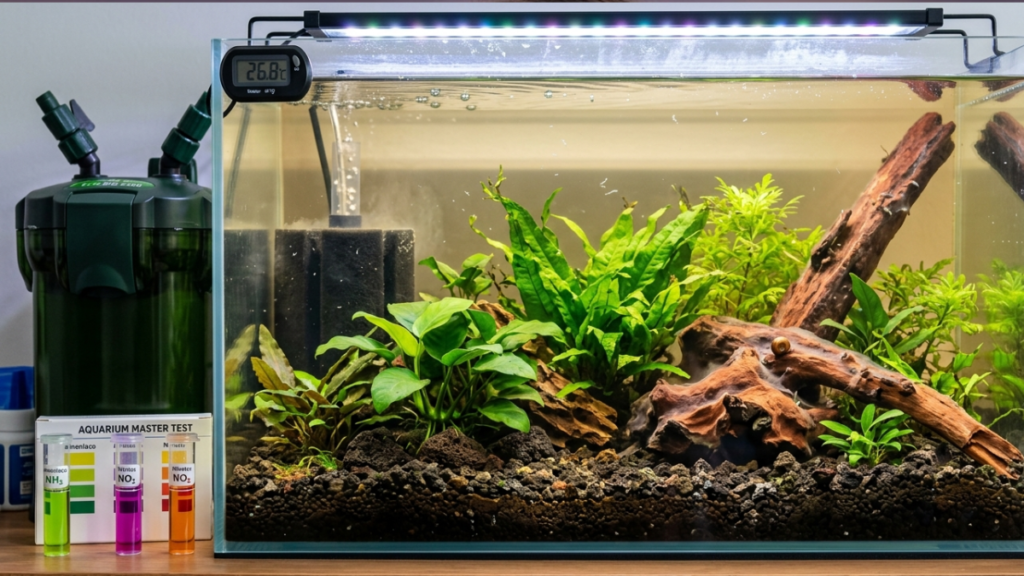
Just brought home a shiny new aquarium? Here’s how to cycle your aquarium properly, avoid the nitrite spike that wipes out beginner tanks, and get your filter ready for fish.
You’re already picturing the colors, the plants swaying, that little pocket of calm in the corner of your living room. Before you open the bag with your first fish, though, there’s one step that separates fishkeepers who succeed from the ones who end up staring at a glass graveyard. It’s called cycling.
If you’re new to this, someone has probably told you “wait a month before adding fish.” But why? What’s actually happening in there? Let’s break down the most important biological process happening in your house.
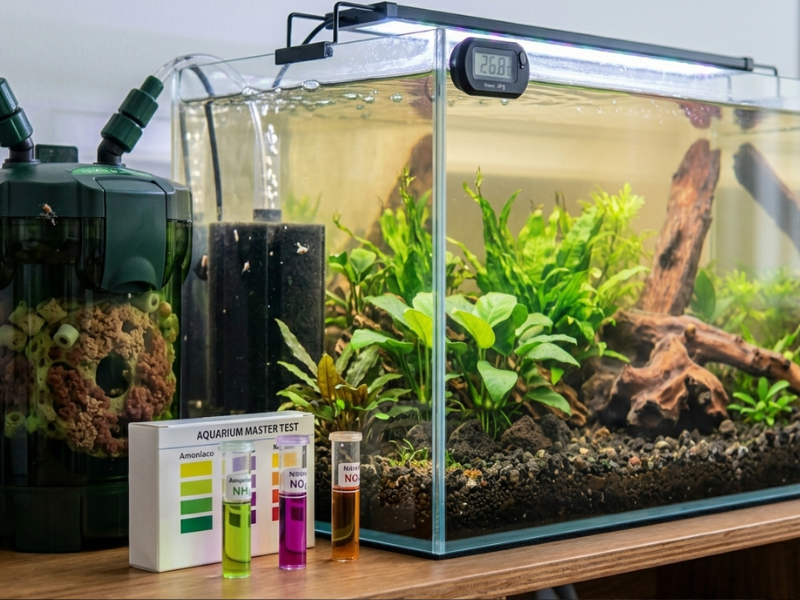
AI-generated illustration
This post contains affiliate links. If you buy through them you’re supporting my work at no extra cost to you
1. What cycling actually is
Cycling isn’t waiting for the water to “settle” or look nicer. Cycling is growing a colony of beneficial bacteria.
Think of your tank as a small city and the fish as its residents. Residents generate waste: pee, poop, uneaten food. In a real city, there’s a sewage system. In your tank, all that waste turns into ammonia (NH₃), which is straight-up poison. Without anyone to haul it away, the fish die.
Cycling is how you hire the sanitation crew. You’re building a colony of bacteria that turn poison into something harmless.
The nitrogen cycle in plain English
Three chemicals, three stages.
- Ammonia (NH₃): what you get when organic matter breaks down. Toxic on contact.
- Nitrite (NO₂): bacteria called Nitrosomonas eat the ammonia and put out nitrite. Still very toxic.
- Nitrate (NO₃): a second group, Nitrobacter, eats the nitrite and puts out nitrate. This one’s only a problem in high concentrations, and you knock it down with water changes or by letting plants use it as fertilizer.
Your tank is cycled when ammonia reads zero, nitrite reads zero, and there’s some nitrate showing up.
2. The gear you need
Before anything else, some tools. You can’t judge a tank by looking at it. Water this clear can still be lethal.
The filter, which is doing most of the work
Don’t cheap out here. The filter’s job isn’t really to grab visible dirt. Its main job is to house the bacteria. You want two kinds of media inside it.
- Mechanical media: sponge or filter floss, which catches the chunks.
- Biological media: ceramic rings, bio-balls, or porous lava rock. This is where the bacteria live. The more porous the material, the more real estate you’re offering them.
A liquid test kit
Skip the color-changing strips. They’re wrong more often than they’re right. Get a liquid kit that reads pH, ammonia, nitrite, and nitrate (the Aquarium Labs kit is a solid pick). This is your only real way to know what’s happening in there.
Water conditioner
Tap water has chlorine in it specifically to kill bacteria. Pour it straight in and you’re killing the exact colony you’re trying to grow. Use a conditioner every single time you add water. It neutralizes chlorine and chloramine on contact.
3. The three ways to cycle a tank
Several methods, all valid, and here’s how I’d pick between them.
A. Fish food (the classic)
The simplest option. Drop a couple of flakes in every other day. The food breaks down, produces ammonia, and the cycle starts.
- Upside: free, and you already have the food.
- Downside: slower, and it leaves debris on the bottom.
B. Pure ammonia (the precise method)
You dose the tank directly with liquid ammonia, unscented, no detergents, until you hit 2 to 4 ppm.
- Upside: precise and faster. You know exactly how much your bacteria are being fed.
- Downside: overshoot the dose and you’ll stall the bacteria you’re trying to grow.
C. Bottled bacteria (the shortcut)
You can buy bottles of live bacteria to jump-start the process.
- Reality check: these aren’t magic beans. You can’t dump a bottle in and add 20 fish tomorrow. They can trim the process from 40 days to about 15, but you still need to test the water the whole time.
4. Week by week: what to expect
Let’s say you’re going with the food method. Here’s the rough timeline.
Week 1: the biological desert
Set the tank up, fill it (with conditioned water), plug in the filter and heater (around 79°F, bacteria like it warm), and drop in a few flakes.
- What’s happening? Nothing visible. The water is crystal clear. You’re going to be tempted to go buy fish. Don’t.
Week 2: the ammonia spike
Keep feeding a little every couple of days. Test the water and you’ll see ammonia climbing. The water might turn a bit cloudy or milky. Don’t panic. That’s a bacterial bloom, and it’s completely normal.
Week 3: the nitrite trap
This is where most people fail. Ammonia starts dropping, but nitrite goes through the roof. Nitrite blocks the fish’s ability to carry oxygen in their blood. It’s the most dangerous stage of the whole process.
Week 4: light at the end of the tunnel
Nitrite starts dropping. For the first time, you’ll see nitrate appearing on the test. The cycle is closing.
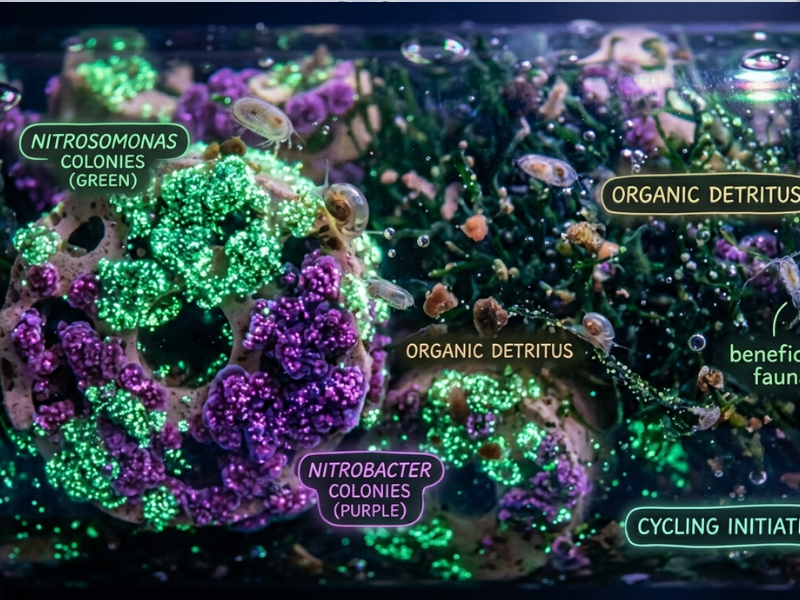
Microscopic view of what’s happening during the cycle
5. The day-15 crisis (when most people quit)
Around two weeks in, the algae apocalypse arrives. Brownish threads or white fuzz covering your driftwood. Forums will tell you to dose chemicals. Don’t do it.
That fuzz is biofilm. It’s the first frontier of life in your tank. It’s the sign that the whole thing is transitioning from an inert object into an ecosystem. Kill it with chemicals and you kill the cycle right along with it. Practice the patience of a Buddhist monk. The fuzz disappears on its own once the bacteria win the fight for nutrients.
| Week | What the test shows | What’s happening under the hood |
| 1 | Ammonia climbing | The sanitation crew is showing up in town. |
| 2 | Nitrite peaking | The city is drowning in garbage, but the recyclers are being born. |
| 3 | Nitrite dropping, nitrate rising | Victory. The infrastructure is running. |
| 4 | 0 ammonia, 0 nitrite | Stable. You can invite the first residents in. |
6. The one shortcut worth taking
If you want to actually speed things up, forget the bottled bacteria for a second (a lot of what you buy is honestly just expensive water, because the bacteria died in shipping when the truck got too hot).
Instead, find a friend who’s had a healthy tank running for years. Ask for a handful of their dirty gravel, or have them squeeze their old filter sponge into a bucket of your water. That gunk is alive. It’s the aquarium equivalent of a microbiome transplant. Bringing life over from an established tank is the only real way to bend the timeline without hurting anything.
7. What nobody tells you affects the cycle
pH and temperature
If your pH drops below 6.0, the nitrifying bacteria start slowing down or dying off entirely. Aim for pH between 7.0 and 8.0 during the cycle. Temperature-wise, keep it between 77 and 82°F.
Oxygen
The bacteria we want are aerobic, meaning they need oxygen to survive. Make sure your filter’s outflow is agitating the surface. Stagnant water means a cycle that takes forever.
Live plants
Should you put plants in during the cycle? Yes, you absolutely should. Plants consume ammonia and nitrate straight away, and they carry beneficial bacteria in on their leaves.
8. Mistakes that torpedo the whole process
- Rinsing the filter under the tap. Wash your bio media in chlorinated tap water and you’ve just erased weeks of work. Always rinse in a bucket of water you took from the tank itself.
- Turning the filter off at night. The filter runs 24/7, no exceptions. Cut the flow and the oxygen stops. The bacteria start dying within hours.
- Over-changing the water. During the cycle, don’t do water changes unless ammonia is so high it’s actually toxic to the bacteria themselves (above 5 ppm). Let the chemistry run its course.
- Rushing it. Fishkeeping is a patience game. Add fish too early and they get chemical burns from the ammonia. That’s not a metaphor.
9. One last piece of advice that’ll save you money
When the test finally clears you to add fish, don’t add ten. Add two. If you load in a crowd on day one, the waste output outruns what your still-young bacteria can handle, and you get an ammonia spike that kills everything. Cycling doesn’t end the day you add your first fish. Cycling ends around the one-year mark, when the whole system is mature enough that it can absorb almost anything you throw at it.
| Parameter | Ideal at the end | Why it matters |
| Ammonia (NH₃) | 0 mg/L | Poison number one. Should already be processed. |
| Nitrite (NO₂) | 0 mg/L | Poison number two. The most dangerous of the three. |
| Nitrate (NO₃) | 5 to 20 mg/L | Proof the cycle is running. You pull it down with water changes. |
10. How to add your first fish without breaking the spell
You’ve hit the day the test shows 0 ammonia and 0 nitrite. You’re thrilled. And this is the exact moment most tanks fail from “too much success.”
Your bacterial colony is big enough to process the flake food or the rotting shrimp you were dropping in. It’s not big enough to handle the waste of 20 neons and 4 angelfish arriving on the same afternoon.
- The 20 percent rule: never add more than 20 percent of the tank’s total intended population at once.
- Wait a week between batches: give the bacteria time to multiply and catch up with the new waste load.
- Don’t feed on day one: your new fish are stressed from the trip. They won’t eat much, and any leftover food will rot and spike the ammonia in a system that’s still fragile.
11. Questions people always ask about cycling
How long does cycling actually take?
Depends. It can run as short as two weeks if you’ve got bottled bacteria and seed media from an established tank, or six to eight weeks if you’re doing it purely from scratch. The average is around 30 days.
The water is cloudy. Should I change it?
No. Milky-white cloudiness is normal at the start. It’s bacteria floating around looking for somewhere to settle. It clears up on its own in a few days.
Can I cycle with fish in the tank?
You can, but it’s cruel and stressful to the fish. It requires daily water changes and constant monitoring just to keep them alive. The responsible approach is to always cycle without fish.
What happens if the power goes out during cycling?
This is where you have to be careful. If the filter sits still for more than two or three hours, the bacteria inside start dying off from lack of oxygen.
If it happens: once the power’s back, watch your ammonia levels closely for the next few days. The cycle may have taken a hit, and you might need a fresh dose of bottled bacteria to repopulate the filter.
Cycling’s done, but my glass is covered in tiny white bugs that move around. Parasites?
Almost certainly copepods or ostracods. Tiny crustaceans that seem to appear out of thin air. They’re a sign your tank is alive and healthy. Your future fish will treat them as live snacks. Don’t reach for insecticides or chemicals. Just enjoy watching your little world start to run.
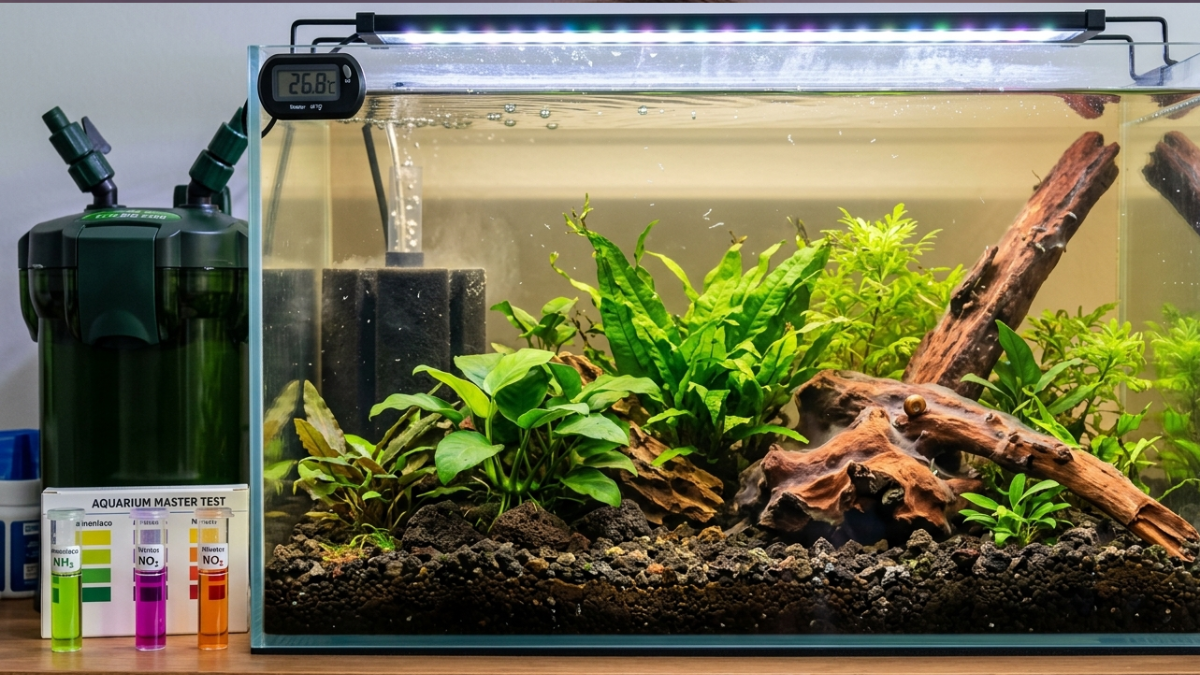
The definitive guide to cycling your aquarium, establishing the nitrogen cycle, and getting your filter ready before adding fish.
Set up and dechlorinate
Assemble the tank, fill it with water, and add conditioner. Chlorine is a disinfectant that would kill the exact bacteria you’re trying to grow. Don’t skip this.
Add a food source
Drop a couple of flakes in every 48 hours, or add a raw shrimp. As they break down, they’ll release the ammonia that Nitrosomonas bacteria need to start colonizing the filter.
Monitor and wait
Test the parameters every three or four days. You’ll see ammonia dropping while nitrite (NO_2) climbs. This is the most critical and toxic phase. Don’t change water and don’t clean the filter.
Confirm the cycle is complete
The cycle finishes when ammonia and nitrite consistently read 0 and nitrate (NO_3) shows up. That means your biological “army” is now big enough to process the waste your fish will produce.
Final water change
Before adding fish, do a 50 percent water change to knock down the accumulated nitrate. Then introduce the fish gradually, a few at a time.
Tools:
- Liquid test kit (NH3, NO2, NO3), filter with ceramic media.
Materials: Water conditioner, fish flakes.
Success starts with patience
Cycling isn’t a nuisance you have to get through. It’s the birth of a living ecosystem. Respect the timeline and your fish live for years, their colors stay vivid, and you don’t spend your weekends treating diseases.
Remember the golden rule: in this hobby, only bad things happen fast. The good stuff, like a proper cycle, takes its time.